























Lots of trends have emerged from the election, but perhaps the most significant was the Democrat’s claim on the future.
Young people across the United States overwhelmingly voted for Democratic candidates in the 2026 midterm elections.
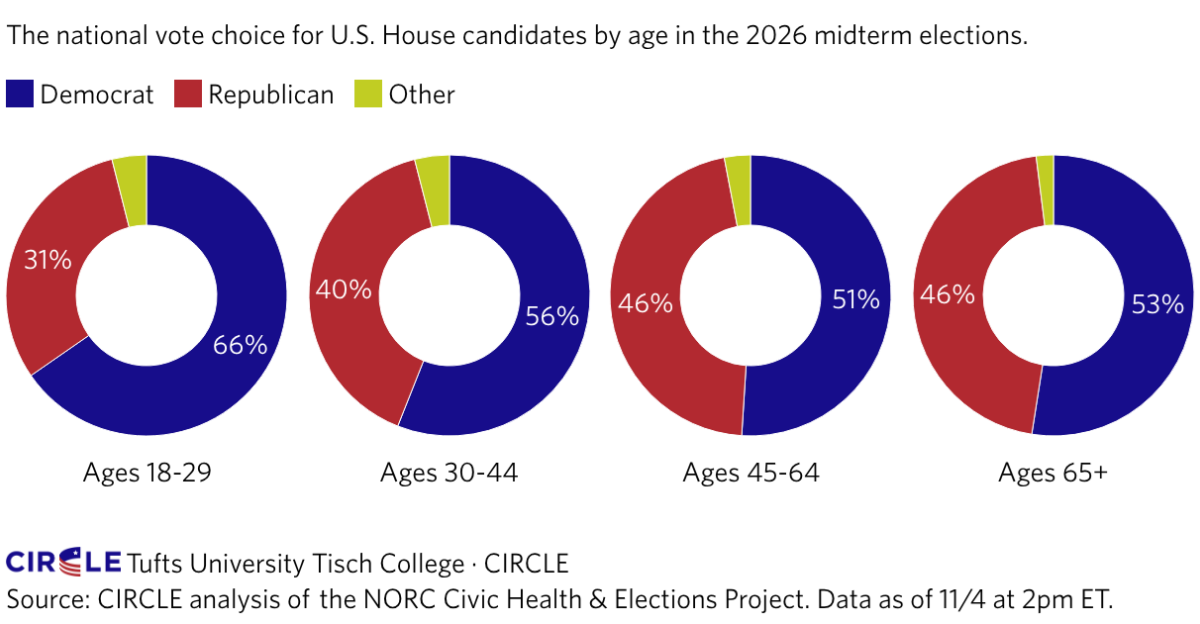
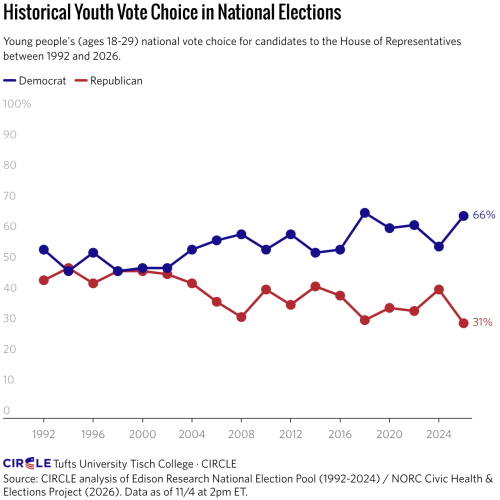
Nationally, 66% of young people ages 18-29 voted for a Democratic candidate compared to 31% for a Republican candidate, according to a Tufts University analysis of election data.
The swing to Democratic candidates is one of the biggest ever seen in a national election and a dramatic swing from the 2024 presidential election.
But Democrats shouldn’t take the youth vote for granted. Nearly half, 43%, identify with neither party and are effectively independent swing voters, according to Rutgers University report.
“Young adults also are becoming discontent with American democracy – losing trust in its institutions and not feeling as if their generation is being represented,” the report states.
The Harvard poll found that just 9% of young Americans say the country is headed in the right direction, matching the Harvard poll’s record low from spring 2024.
Among young Americans overall, 77% disapprove of Trump’s handling of the economy, and 63% said their congressional vote reflected opposition to the president and his policies.
In contrast, the youth vote was trending toward Republicans in 2024.
The Democratic lead for that crucial demographic was just 14 percentage points for Democratic House candidates and 11 points in the presidential race, according to Edison Research. Young 2024 voters backed Kamala Harris over Trump by just 4 points.
Clearly, America’s youth was decisive in many of the midterm races.
While 66% of youth nationally voted for a Democratic House candidate, that percentage drops across other age groups. Among age 30-to-34 voters, 56% backed Democrats. Voters age 45 to 64 split 51% to 46% for Democrats; while voters 65-plus broke 53% to. 46% for Democrats.
The Tufts University and Harvard Youth Poll found young voter concerns focused on critical economic, social, and foreign policy issues.
For the first time in the history of the Harvard Youth Poll, more young Americans expect to fall behind their parents financially (27%) than to move ahead (25%).
High inflation, the cost of living, and housing security remain the absolute highest priorities across the entire demographic.
Young voters see high mortgage interest rates freezing them out of owning a home and inflation erode their purchasing power. Plus, thousands are saddled with expensive student loans that delay their entry into the middle class and household formation.
Technology concerns have translated into economic ones, with 64% of young adults viewing AI-driven job displacement as a serious threat to their financial future.
Climate change, combating racism, and expanding healthcare access also topped the list of concerns. The war in Iran emerged as a major, high-priority foreign policy issue across ideological lines.
When the Constitutional Convention ended in 1787, a a prominent Philadelphia socialite asked Benjamin Franklin whether the nation would have a republic or a monarchy.
“A republic, if you can keep it,” Franklin tartly and prophetically replied.
Franklin’s words have hung heavily over the last two years, as President Trump pushed the nation into authoritarianism in the face of a complicit Republican Congress and a heavily conservative Supreme Court.
But in the recent midterm elections, the public made their choice clear… a republic.
Let’s hope we can keep it into the future.
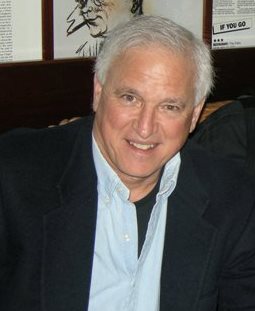
Keith Girard has four decades of experience as an award-winning reporter, editor-in-chief, and senior media executive. Keith’s career began in Washington, D.C., where he was a reporter for The Washington Post and a contributing editor for Regardie’s and Washingtonian magazines. He also worked as a writer/producer in CNN’s Washington Bureau and has written non-fiction books on the U.S. Marines in the Gulf War and Donald Trump and two novels, “The Heidelberg Conundrum” and “The Curse of Northam Bay.”