
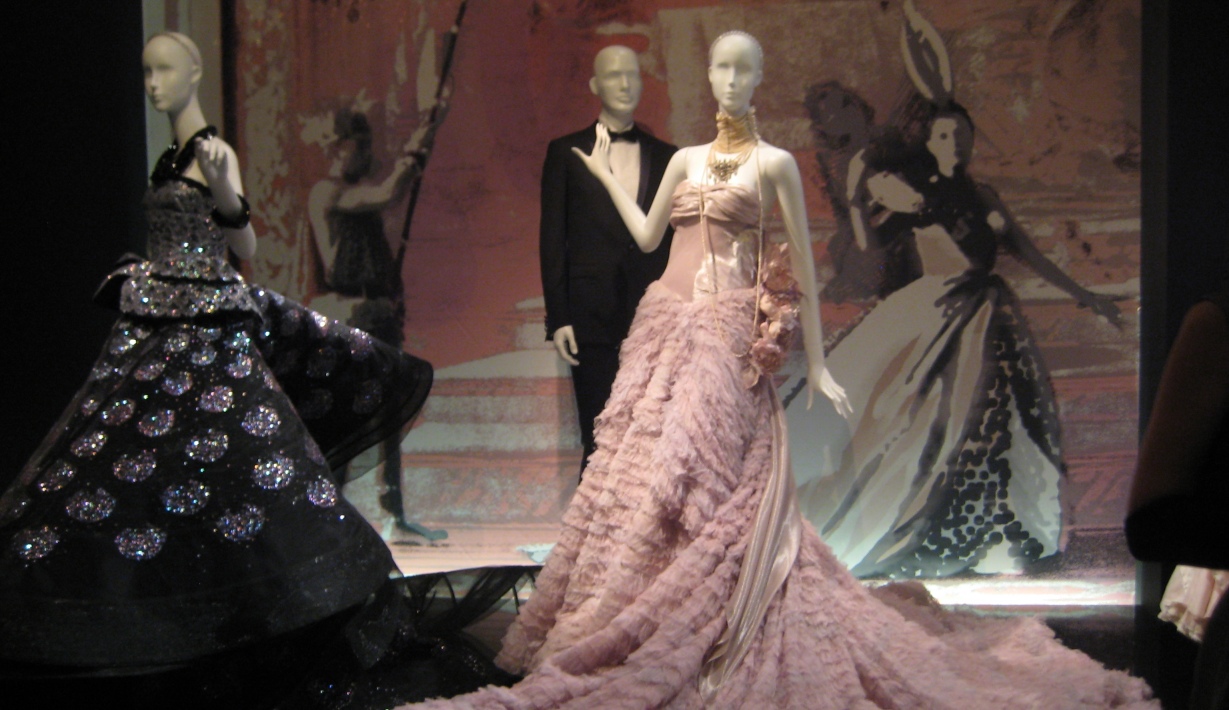
The Metropolitan Museum of Art is under growing fire for chosing to honor British fashion designer John Galliano at its Costume Institute this year. It may be a tempest in a teapot.
Galliano’s fashion was as outrageous as his personal behavior. He was infamously anti-Semitic, verbally abusive to… well, just about everyone, and constantly trashed other designers, according to Dana Thomas, a biographer.
Thomas wrote in The New York Times today (Aug. 7) in a guest opinion that The Met is making a huge mistake honoring a man with such a disreputable past.

But if personal behavior is the standard for deciding who should receive honors for their art, then what about Paul Gauguin?
The 19th century French Post-Impressionist painter completely rejected conventional society. He ditched his wife and five children, moved to Tahiti and indulged his sexual obsession with very young teenage girls, outraging local authorities and missionaries.
Caravaggio (1571–1610), the brilliant Italian Baroque painter, had a violent temper that matched the dark, dramatic style of his art.
American abstract expressionist icon Jackson Pollock (1912–1956) struggled with severe, lifelong alcoholism and a volatile temper.
He routinely destroyed property during drunken rages, once flipping a dinner table at a gathering of friends. His erratic behavior and infidelity tore his marriage apart, and his life ended tragically when he crashed his car while driving drunk, killing himself and a passenger.
Oscar Wilde was one of the most popular playwrights in London when he began a scandalous affair with Lord Alfred Douglas, 16 years his junior and married with two kids.
More Reading: Met Returns Stolen Artifacts Amid Rising Global Thefts That Often End Up in Major Museum
Indeed, if the Met applied the same standards that Thomas is advocating for Galliano, then the museum would have to scour its walls and dramatically reduce its collection.
So why Galliano, and why now?
It’s easy to attribute the controversy to “wokeism,” applying a contemporary standard of morality to age old bad behavior. But there is likely more to it than that.
During his heyday, Galliano’s fashion was wild, off the charts, confusing and widely detested by the fashion industry and its leading patrons.
Willams recalls a specific incident that capsulized the sentiment for Galliano during his time at Dior:
“I was sitting in a row with Madame Chirac and Madame Pompidou and they looked like they had been hit in the face with a cold dead fish,” the New York socialite and longtime Dior client Nan Kempner told me after the show. “They couldn’t believe what they were looking at: this conservative house where they’ve all bought their clothes for years. How much was there that Madame Chirac or Madame Pompidou could wear?”
Read More: NY City Doomed? Fuggetaboutit! Get Ready for the Next Renaissance Instead
The answer was not much. Williams continues:
“For his first Dior haute couture show, staged at Le Grand Hotel in January 1997, he presented a mash-up of Edwardian dressing, 19th-century Japonism and Maasai tribal wear, including bustled gowns, cinched corsets draped with tiny yellow and orange ceramic beads, and an opium-den-like sheath in chartreuse satin trimmed with mink — a look Nicole Kidman wore to the Oscars two months later.”
Incidentally, his tenure at Dior came to an abrupt end following a drunken antisemitic tirade in a Paris cafe.
For its part, The Met is not ignoring Galliano’s personal behavior or the current cultural climate.
“Alongside Galliano’s extraordinary creative accomplishments, the exhibition will address the derogatory conduct that fundamentally altered his career and public reception. In doing so, the exhibition will consider how artistic achievement should be understood alongside ethical accountability,” the museum states in a release.
“The Met is attempting to tackle questions regarding cultural memory, accountability, rehabilitation and reputation. In the process, it is asserting the ability of powerful cultural institutions to decide when achievements of talent outweigh failures of morality,” Williams writes. “I think it is a terrible idea.”
Many fashion insiders and patrons who buy outrageously expensive clothes still resent Galliano for what he did to Dior, transforming a conservative couture house into a fashion rave.
A more substantive knock against the upcoming exhibit is its crass commercialism. Galliano is 65 and still working. After his spectacular departure from Dior, he was the creative director of Paris fashion house Maison Margiela from 2014 to 2024.
He has also been named British Designer of the Year four times, and was named the fifth most influential person in British culture in a 2004 BBC poll.
What’s more his designs are undergoing a revival among young style setters like Kylie Jenner (with apologies to style setters).
The actress Zendaya wore a rare Galliano Spring/Summer 1997 “Circus Collection” celestial slip dress featuring a dazzling beaded spiderweb design.
Actress Jennifer Lawrence wore a vintage Galliano-for-Givenchy gown (originally worn by Kate Moss in 1996) at high-profile Oscars after-parties.
Leading the list of popular vintage Galliano design are his 1997 “Circus” & “Titanic” Collections, celebrated for fluid, bias-cut slip dresses with intricate embroideries and webbed motifs; Galliano-Era Dior (late ’90s–2000s) saddle bags, newspaper-print patterns, butterfly/floral embroidery, and embellished Y2K denim corsets and early Givenchy (1996) for its romantic, intricately beaded, and precise bias-cut evening gowns.
Needless to say, elevating Galliano to a pedestal at The Met will be a major boon to his reputation and career. Only two other living designers have been so honored: Yves Saint Laurent in 1983 and Rei Kawakubo of Comme des Garçons in 2017.
The Met’s choice (was it pushed by Vogue Editor Anna Wintour and sponsors?) is certainly fodder for debate. And, Galliano won’t be the first to draw protesters.
But the real question is where is The Met taking the event? It’s grown over the years from a mere “exhibit” into a flashy display of notoriety and wealth. First the celebrities moved in and now the billionaires are arriving in black limousines. Amazon billionaire Jeff Bezos and wife Lauren Sánchez Bezos are this year’s co-chairs.
The event reminds me of my old Upper East Side neighborhood bar. For years, it attracted a small, eclectic crowd from many of the foreign consulates that dot the neighborhood. Then, it was written up in a local magazine, and its character totally changed.
It was mobbed to standing-room-only every weekend by outsiders. I knew my days there were over when I spotted Colin Farrell standing outside one night amid the throng.
The Met long ago turned the event into a spectacle of conspicuous consumption. After all, that’s what high fashion has become. Love it or hate it, Galliano’s work should stand on its own.
Images on this post are licensed under the Creative Commons Attribution-Share Alike 3.0 Unported license.
Keith Girard has four decades of experience as an award-winning reporter, editor-in-chief, and senior media executive. Keith’s career began in Washington, D.C., where he was a reporter for The Washington Post and a contributing editor for Regardie’s and Washingtonian magazines. He also worked as a writer/producer in CNN’s Washington Bureau and has written non-fiction books on the U.S. Marines in the Gulf War and Donald Trump and two novels, “The Heidelberg Conundrum” and “The Curse of Northam Bay.”