
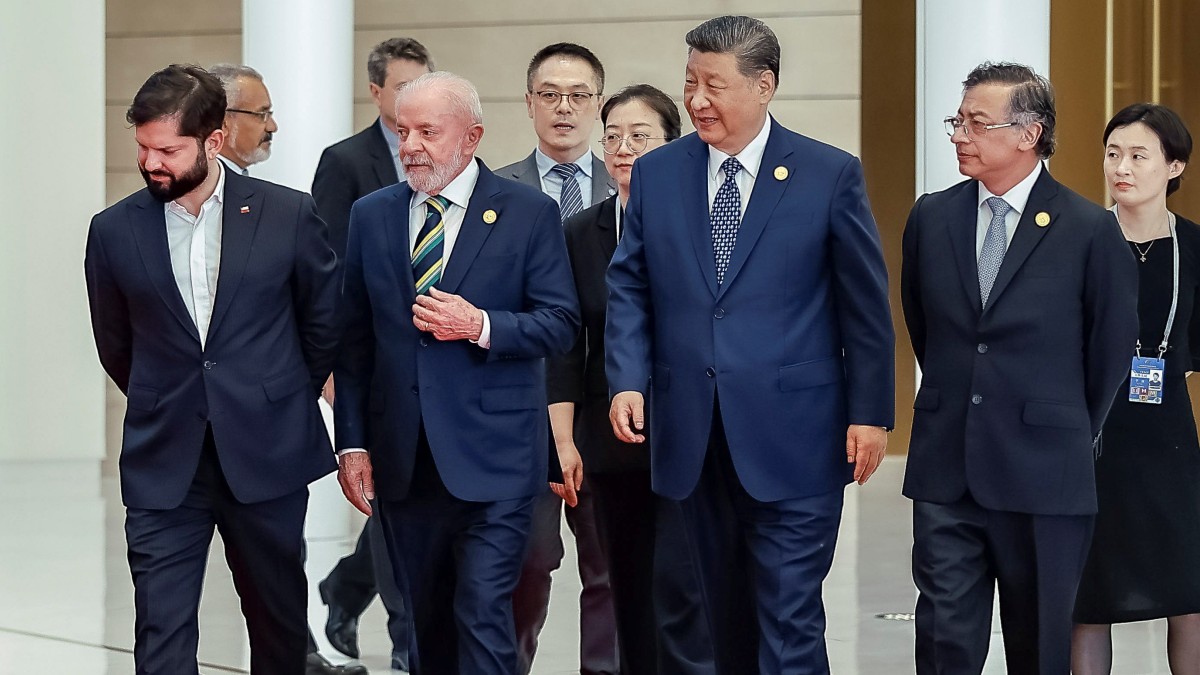
A Latin American delegation visted China for the 2025 China-CELAC Forum, a symbol of China’s growing influence in the region. (Photo: )
China and Chinese organized gangs have been expanding their influence in Latin America aided by sharp Trump administration cutbacks to the region, posing a rising national security threat.
During his first term, Trump slashed roughly $500 million — or roughly 36% — of congressionally approved aid to the “Northern Triangle” countries (Guatemala, Honduras, and El Salvador), threatening development and democracy-building programs across the hemisphere.
A massive $60 billion cut in global foreign assistance in 2025, mostly through USAID rollbacks under Trump’s misguided DOGE reform, further slashed an estimated $2.5 billion annually in U.S. Latin American assistance.
China Gains Massive Latin American Influence on Heels of Disastrous Trump Policies
The budget proposals have severely impacted or eliminated regional funding—including support for the Organization of American States (OAS), local human rights organizations, and democracy-defense groups in nations like Cuba, Venezuela, and Nicaragua.
More sigificantly, the assistance gave the United States important leverage in the region and was a bulwark against foreign influence from U.S. adversaries, like China. But the reductions left Latin American governments struggling to fill the void, and China was all too willing to step in.
The Communist nation has been trying to make inroads south of the border for more than two decades, but Chinese initiatives have gained traction, following Trump’s withdrawal from the region.
Chinese criminal networks have expanded in the region as well, alongside China’s legal trade and investment, according to an eye-opening report by the Brookings Institution.
More Reading: Trump Treason: Stolen Top Secrets Tied to Saudi Money
Their activities span trafficking of drugs and their precursors, money laundering, illegal, unreported, and unregulated fishing; wildlife trafficking; illegal logging and mining; and human smuggling.
“All of these illicit economies and this highly violent criminality long predate the arrival of Chinese criminal groups,” the report notes.
“But the presence of Chinese criminal groups often leads to a dramatic increase and diversification in illicit extraction and smuggling, such as in natural resources contraband, because the demand for such products in China is very large.”
Chinese criminal networks are the principal suppliers of precursor chemicals for the production of fentanyl and methamphetamine for Mexican cartels, which ultimately ends up on U.S. streets. They also supply chemicals for processing cocaine across Latin America.
The extent of Chinese precursor chemicals flowing into Latin America can’t be underestimated In April 2012, Belize intercepted a Chinese shipment of precursor chemicals bound for Mexican cartel “Los Zetas.” The shipment was sufficient to produce an estimated $10 billion in methamphetamines.
More Reading: Israel-Hamas War: Donald Trump Foreign Policy Blunders Set Stage for Conflict, Strife
Chinese underground banking networks have become the top money launderers for Mexican cartels, displacing other long-established money laundering systems in the region, according to the report. Chinese criminal gangs often work hand-in-hand with their Latin counterparts.
Trump claimed his sharp cuts in Latin American aid were designed to to pressure governments to curb migration at the U.S. southern border. But the cuts have had the opposite efffect.
Human trafficking from Asia through Latin America to Canada and the United States is the largest visible transnational criminal linkage between the two regions, according to Jamestown Foundation, a non-partisan global research organization on Eurasian security and political developments.
It is highly lucrative for the groups involved, generating $70,000 or more per smuggled person for the criminal organizers.
Oops! Trump Calls US Ally Fighting ISIS a Terror Group In New Foreign Policy Gaffe
Officially, China is flooding the region with economic development funds and other assistance, which increases the likelihood of Chinese espionage.
Chinese President Xi Jinping has visited ten Latin American countries—Argentina, Brazil, Chile, Costa Rica, Cuba, Ecuador, Mexico, Panama, Peru, and Venezuela — since gaining power in 2012.
In 2014, China launched the China–CELAC Forum, an organization of top Chinese and Latin American government heads that meets annually. it serves as “the primary platform for advancing political dialogue, economic collaboration, and cultural exchanges between China and the various regions,” according to the group.
Since 2017, during the first Trump administration, China has become South America’s top trading partner and a major source of both foreign direct investment and energy and infrastructure lending, including through its massive “Belt and Road Initiative,” according to the Council on Foreign Relations.
Beijing has invested heavily in Latin America’s space sector and has strengthened its military ties with several countries, particularly Venezuela.
In 2000, the Chinese market accounted for less than 2 percent of Latin America’s exports, but China’s rapid growth and resulting demand drove the region’s subsequent commodities boom. By 2021, trade exceeded $450 billion—a figure which grew to a record $518 billion in 2024, according to the council.
While President Joe Biden saw China as a “strategic competitor” in the region, and significantly increased aid during his term, Trump has pushed punitive and assertive economic measures that experts say could push countries further toward China.
In fact, during Trump’s recent trade war with China, the communist nation was able to cut off all U.S. soybean purchases by shifting is imports to Venzuela and other South American nations.
A number of Washington think tanks have been clamoring for years about China’s growing influence, and finally Congress is beginning to respond, although the effort may be too little, too late.
A bill pending before the Senate Foreign Relations Committee would would authorize the Department of State to build the capacity of Caribbean and Latin Americam law enforcement agencies to disrupt and prosecut transnational Chinese criminal organizations. But the measure only provides a paltry $25 million over the next five years, according to the Congressional Budget Office.
Most of the money would go to “facilitating consultation” between law enforcement agencies in those countries and their counterparts in the United States and providing training about financial investigations, money laundering, and illicit finance. The measure would also provide for technical and forensic assistance.
Perhaps most importantly, the bill would require the State Department to report on organized crime in the Caribbean and
Latin America linked to China.
Whether the Trump administration will wake up to the threat remains problematic. Trump appears willing to bend over backwards to placate Xi Jinping. Under Trump, the United States has been under general retreat around the world, and he shows no inclination to change that course.
The net result is not only a reduction in U.S. influence around the globe but an open invitation to nations like Russia and China to increase their influence in third world countries.
Keith Girard has four decades of experience as an award-winning reporter, editor-in-chief, and senior media executive. Keith’s career began in Washington, D.C., where he was a reporter for The Washington Post and a contributing editor for Regardie’s and Washingtonian magazines. He also worked as a writer/producer in CNN’s Washington Bureau and has written non-fiction books on the U.S. Marines in the Gulf War and Donald Trump and two novels, “The Heidelberg Conundrum” and “The Curse of Northam Bay.”