






















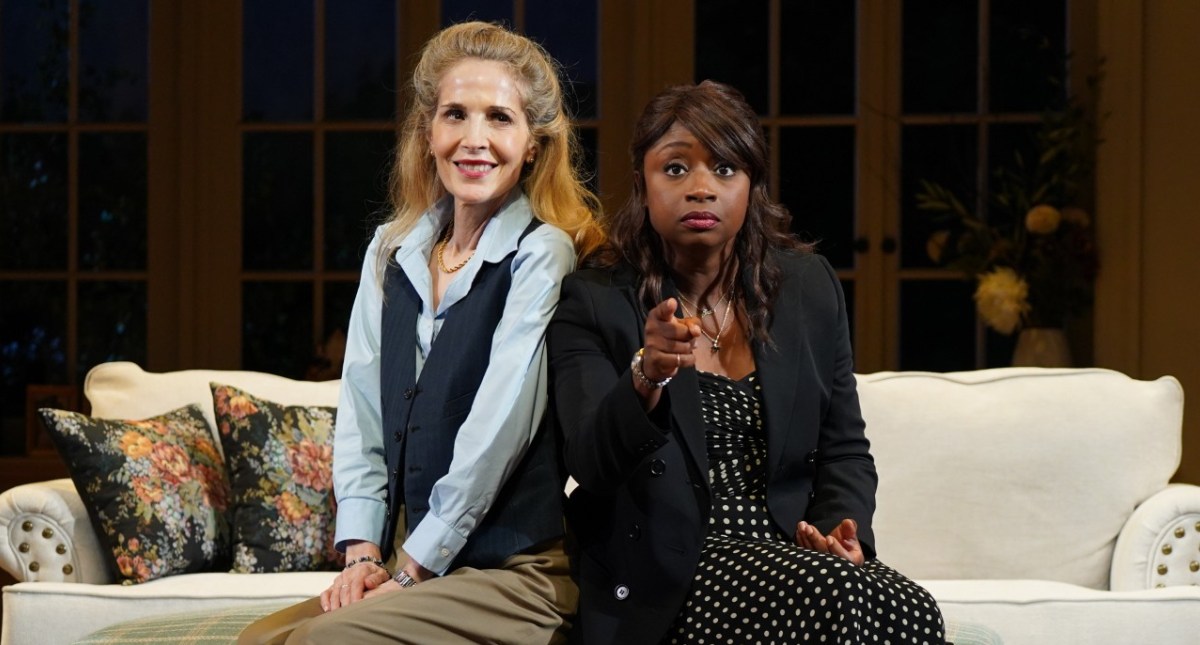
Wendy Wasserstein’s play, An American Daughter, premiered in 1997, but its exploration of politics, feminism, media scrutiny, gender and the expectations placed on women feels as timely as ever 30 years later.
Tony Award nominee Montego Glover (Memphis, Gypsy) stars as scientist Dr. Judith B. Kaufman in the first New York revival, now playing at The Irene Diamond Stage at The Pershing Square Signature Center.
The play, featuring Sarna Lapine’s staging for La Femme Theatre Productions, follows a successful physician and political nominee Lyssa Dent Hughes played by Jean Lichty. Hughes’s public image begins to unravel under intense media scrutiny, following her nomination to be U.S. Surgeon General.
Judith, her longtime friend who is struggling to get pregnant at 40, offers a thoughtful perspective on the challenges facing women in public life.
Things spiral out of control when Hughes’ insecure husband, Walter (Robert Sean Leonard), undermines her. He inadvertently tells TV journalist, Timber Tucker (Chris Ghaffari), about a gaff involving an ignored jury duty summons.
The cast also includes Morrow (Ryan Spahn), Walter’s anti-abortion, gay, right-wing pal; her Republican father, Alan (Dakin Matthews), and his brand-new fourth wife, Chubby (Mary Beth Peil); and Quincy Quince (Carmen Zilles), a Gen X feminist eager to publicize her new feminist book.
Wasserstein died 20 years ago, at 55, but a newly restored and unpublished second act offers audiences a chance to rediscover why An American Daughter continues to resonate three decades later, Glover says.
Glover spoke with The New York Independent about bringing her own perspective to Judith, the character’s achievements and struggles, and the humor, intelligence and humanity at the heart of Wasserstein’s work.
NYI: What makes this production of An American Daughter especially meaningful to you?
Montego Glover: There are a lot of Wendy Wasserstein fans in New York City and around the world, but this is very exciting for us because Wendy’s play is being done in a city that loves her and loves her memory. The fact that we are bringing a new and unpublished second act is tremendous because it is not very often allowed with her work. She managed to do something extraordinary in her career which is receive both a Tony Award and a Pulitzer, and the privilege of working on her writing is a tremendous honor for me.
NYI: An American Daughter premiered thirty years ago. Many audiences say it still feels remarkably timely. Why do you think Wendy’s play continues to resonate today?
Glover: Wendy is talking about the treatment of women, feminism, the media, politics; how we manage our communities around politics and media; and what was really the beginning of the world of the political ground as we know it today.
NYI: Which of those themes feels most urgent to you in 2026?
Glover: The correct answer to that is all of them, because as strange as it seems, they have all been intertwined. [All of those issues] have become a part of how we experience media, gender, politics, feminism, information, and community. There is currently a need to separate them so that we can have the best possible version of them, but they have sort of become one multi-headed piece.
NYI: Wendy Wasserstein had a unique ability to blend all of those topics with sharp political commentary and humor. How does that shape the audience’s experience of Daughter?
Glover: I think it gives the audience a very human experience with all of these very big ideas and pieces and parts of human life. She’s very astute and I find that mixing humor, sharp wit, and extreme intelligence produces a full experience. We hit all of the parts of what it is to be involved in the center of this story, as well as to be on the outside observing a thing that is happening. Wendy and this play are remarkably prescient.
The best plays are those in which the actors are experiencing these emotions and going through the roller coaster with the audience.
It’s very important to us that we see the full picture of these characters and see how they fit together in the telling of the story.
NYI: What initially appealed to you about playing Dr. Judith B. Kaufman?
Glover: What drew me to her is Wendy’s rendering of this woman. I think she’s very intelligent. Judith is a professional. Like so many women, she has her struggles, she has her extraordinary achievements, and she has a friendship with another woman. I think a part of the experience of being a woman-but also the experience of feminism-is recognizing that being in the lives of other women is hugely important. It’s actually a part of your lifeblood and the feminine experience.
NYI: Were there aspects of your character that surprised you during rehearsal?
Glover: Yes, and I have to thank Wendy for it because it’s all in her arrangement of words and what she chooses to say and not to say. There were many wonderful surprises! Interestingly enough, the ones that you find on the first read, and then the second, the third, and then the fourth and fifth…you just keep discovering where Wendy was going and how deeply she was expressing and also commenting on the people, the events, and the places central to the time and story. The fearlessness of Wendy’s writing is that Judith’s struggle is very much forward. There is no effort made to hide behind a face or a façade. I appreciate that very much. It’s surprising because you would think the opposite would be true. After such meaty roles as Memphis’ Felicia Farrell and Gypsy’s Mama Rose, there is no one more equipped to take people on the feminist journey. Wendy has given me an extraordinary woman to put my arms around. I really appreciate and am so grateful and excited about the journey that Judith and I are taking together.
NYI: How are you making this version of the character unique to you?
Glover: I’m making sure that I’m clear about the ways Judith and I are the same, and celebrating the ways we are different. I’m taking nice, juicy bites into those wonderful differences so that I can sharply illustrate her to the best of my ability. I find her remarkably interesting and endlessly entertaining, and I think Wendy’s brilliance and her writing keep surprising you. She definitely infused a lot of that heart, spirit, sharpness, grounding, and wit into Judith.
NYI: When it comes to the impossible standards that are often placed on women in positions of power, have those expectations changed in the last thirty years, or do they simply take different forms today?
Glover: They do both of those things. They stay the same and then they change because they need to stay the same. For example, if women want a family, most will first try in the old-fashioned way. They want to find a partner and form a family unit. There is a drive that all humans have to develop community and their own family units. But, as things evolve, as we experience the passage of time, the way to get to a family can be different and just as legitimate. The real life that needs to be lived is reconciling the old with the new, the “where we’ve come from” with “where we’re going.” We’re still looking for what brings us groundedness, joy, and the feeling of a life well-lived, with purpose. Sadly, for many people now, social media is their way of feeling purpose and finding a community. The play raises a lot of questions about authenticity versus public image.
NYI: How do you think audiences are connecting with that today, particularly in the age of social media?
Glover: I think they are connecting with it in very robust ways. They can be strong or prolonged reactions, but I think it causes people to examine their own viewpoints and how they are participating in the big structure in all of it. Are they influencing it in ways that are positive and build community? Or are they a part of the problem? There’s a real need to be aware and to constantly examine yourself with the intent of contributing in a way that is purposeful. That doesn’t always take place. Not everyone is contributing in a way that is positive or useful.
NYI: You’re always working on a number of projects. Is there anything on the horizon that you would like to share?
Glover: Nothing that I can talk about, except I joined the cast of “Alma’s Way” for PBS Kids. We have done season three. I was delighted to be in the studio to voice [a character named] Dr. Kayla Wall. She’s also a scientist!
NYI: If you could ask Wendy one question today, what would it be?
Glover: “Did you know where we were headed?” I wonder what she would say.
For more information about An American Daughter, which has been extended through Sept 20, visit An American Daughter | La Femme Theatre Productions.

Iris Wiener is an entertainment writer, editor, reporter and theatre critic based in New York. Her portfolio contains a diverse collection of work on all genres of entertainment. Her reporting has been featured in more than twenty publications, including Newsday, Playbill, TheaterMania, Encore Monthly, Weston Magazines, and Long Island Woman. She is a proud voting member of the Drama Desk and The Outer Critics Circle.