





















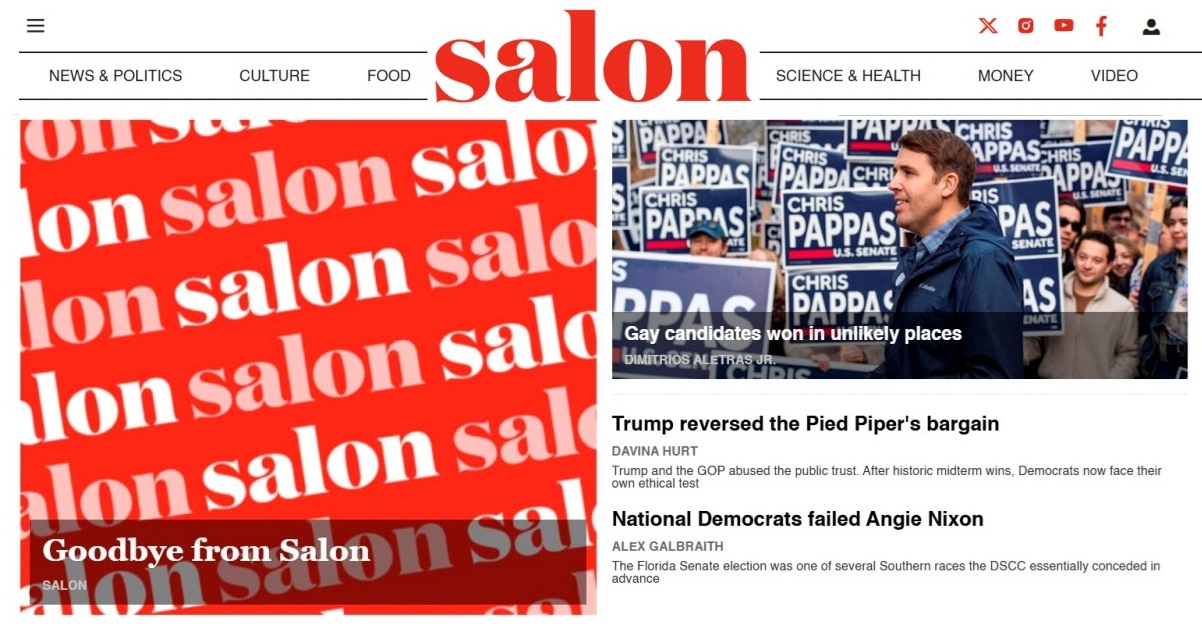
Salon, an independent Web magazine founded during the Internet’s early heyday, is closing, killed by Google and a burgeoning trend that threatens all but the very largest media publications.
Salon Chief Content Officer Erin Keane confirmed today (Nov. 6) the site is closing effective immediately, leaving 19 full-time employees and several contractors, jobless.
“The business realities of independent digital journalism have changed profoundly over the years, the publication wrote in a farewell note. “After careful consideration, we have reached the difficult decision that our publishing model is no longer sustainable.”
Google’s shift from a pure search engine to an AI-driven “answer engine” has raised profound questions about lifting information from websites to fuel its latest initiative. It involves potentially massive copyright violations — a multi-billion-dollar legal question that is currently being litigated both in the United States and Europe.
Book authors, artists, and prominent media organizations (such as The New York Times’ lawsuit against OpenAI) claim AI answer engines are using their proprietary information to drive its answer engine without compensation.
Salon has had its ups and downs over the years from a business standpoint, but the site’s death is directly attributable to Google and AI-driven search engines.
In fact, the last five years, (2021 to 2026) have been widely referred to by media analysts as a “digital media bloodbath.”
Such once prospering sitesa Buzz Feed News, Jezebel, Pitchfork and Jet magazine, have all disappeared during the digital apocalypse.
In industry circles, the hobgobblin consuming online pubications is known nefariously as “Google Zero.”
It’s not an official Google product or software update. Instead, it describes a massive shift in how the Internet works, fueled by the evolution of “answer engines” driven by aritifical intelligence like Google Gemini.
Google is locked in its own existential battle with other AI engines, such as OpenAI, Microsoft, Perplexity, and Apple. The fierce competition is to capture or hold on to users with clean, quick answers, even if it damages the internet’s infrastructure tomorrow.
When, the internet came into its own in the 1990s, it provided a medium for thousands of online sites to reach the public. Search engines stepped into the fray to organize and in many ways police the web by creating search results and filtering out sites it deemed unreliable or untrustworty.
Publishers created content, Google indexed it, and Google sent searchers to the publishers’ websites. Google, in turn, placed ads on the sites and split the revenue — a true symbiotic relationship.
But Google, by far the largest search engine in the world, is slowly killing that model.
In its place, it’s turning its search engine into an “answer engine,” using AI to summarize information at the top of search results. Most readers get all the information they need from that and don’t click through to the web publications from which it’s summarized.
So-called answer blocks means that a massive portion of web searches are resolved directly on Google.
Nearly 68% of Google domestic searches now result in “zero-click” results, leaving less than a third of searches to actually yield traffic for external sites, according to 2026 data from SparkToro, an AI market research company.
The shift has dried up traffic for largely independent sites that bought into the Google bargain of trading search traffic for ad revenue.
The crisis has reached existential proportions for the online publishing industry. So-called Search Engine Optimization (SEO), the backbone of online publishing no longer works.
Now, publications are scrambling to adopt “Generative Engine Optimization (GEO),” trying to optimize content so AI answer systems cite it as a source for an AI summary. But even that is a red herring.
When users find everything they need directly on the search results page—via AI Overviews, Featured Snippets, or Knowledge Panels—the traditional search funnel breaks.
While litigation grinds through the courts, the shift to answer engines is producing a potentially fatal paradox for Google as well as web publishers.
Google’s AI-driven answer engine is incapable of generating the original content necessary to create the summaries that now appear on the search engine. They rely entirely on human beings to do the expensive, time-consuming work of creating original content.
Then they cannibalize the information from the very web publications that it’s slowly starving of traffic and revenue.
Even it’s own advertising program, “Google AdSense,” is suffering as fewer readers visit sites and click on Google ads. Ad revenue drops to zero for both the publisher and Google.
By driving independent publishers out of business, Google is actively destroying the very ecosystem that fuels its search and AI models. This creates a massive long-term risk for both the open web and tech companies themselves.
Publications are fighting back by shifting to direct sponsorships, premium subscriptions, or locking their content behind paywalls that block AI crawlers.
Publishers paywalls blocking AI data scrapers and private apps will eventually force Google to survive on a diet of mostly of low-grade, automated spam sites.
If Google’s AI web crawlers can no longer find fresh, human-generated articles, they will inevitably begin scraping and training on text that was already written by AI on the web.
When an AI model is trained on AI-generated data, it suffers from “Model Collapse,” according to research by computer scientists.
Over successive generations, the output degrades, errors compound, and the AI effectively becomes a xerox of a xerox—eventually spitting out nonsensical, repetitive garbage.
Google is getting around the problem — and copyright issues — by licensing content from major sources. For example, OpenAI signed a reported $250 million deal with News Corp, owner of Fox News and various publications and a $200 million licensing deal with Reddit.
But as Salon shows that doesn’t work for many smaller, independent sites, no matter the quality of their content.
Ultimately, Congress may need to step in to level the playing field and resolve copyright issues instead of relying on endless litigation.

Keith Girard has four decades of experience as an award-winning reporter, editor-in-chief, and senior media executive. Keith’s career began in Washington, D.C., where he was a reporter for The Washington Post and a contributing editor for Regardie’s and Washingtonian magazines. He also worked as a writer/producer in CNN’s Washington Bureau and has written non-fiction books on the U.S. Marines in the Gulf War and Donald Trump and two novels, “The Heidelberg Conundrum” and “The Curse of Northam Bay.”