





















The promised Trump “Golden Era” is quickly turning to tin as consumers face an affordability crisis in the face of higher than expected inflaton and an endless war in Iran.
It’s clear the Trump administration has sent the economy spiraling downward since Donald Trump launched his unprovoked war against Iran in February. What was supposed to take two weeks to finish, has now gone on for months with no end in sight.
Beside choking oil supplies through the Strait of Hormuz, the war has cost the lives of at least 21 soldiers, hundreds of wounded and tens of billions of dollars.
More Reading: Never Thought About Bonds Before? Better Think Now, Rising Yields Are Crushing the Economy
Frustration over the economy has driven Trump’s poll numbers to an all-time low. Only 30% of Americans say he is doing a good job managing the economy. Polls continue to suggest a Democratic midterm sweep in November with the economy as the defining issue.
The impact is reflected in the latest economic numbers.
More Reading: Trump Economy Squeezes Homeowners, Foreclosures Rise 26%; Red States Hardest Hit
 The widely watched consumer price index, which measures a broad measure of domestic goods and services costs, rose a seasonally adjusted 0.6% for the month, putting the 12-month rate at 3.7%, the Bureau of Labor Statistics reported today (Oct. 14)
Economists were looking for respective gains of 0.6% and 3.6%, according to aDow Jones survey.
Even without volatile food and energy costs, core CPI rose 0.3% for the month and 2.6% on an annual basis, also higher than expectations of 0.2% and 2.5%, respectively. Headline inflation was 3.4% in August and the core rate was 2.4%.
More Reading: Trump’s Not Good, Very Bad Day: Gas Going Dry, Missiles MIA, $6 Diesel Bites, Economy Swoons
“CPI came in hot and it wasn’t just fuel prices,” Sonu Varghese, chief macro strategist at Carson Group, told CNBC.
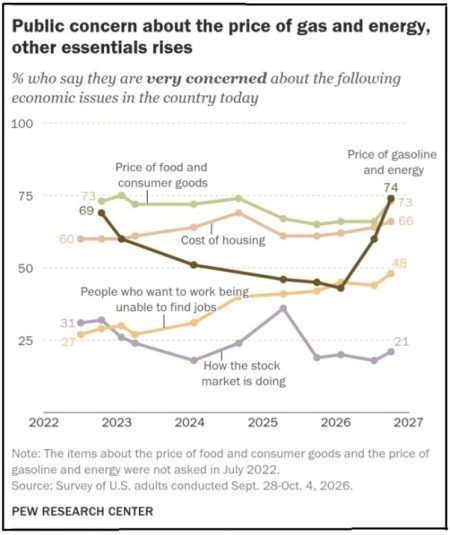
Meanwhile, almost half of all Americans are struggling to pay for basic needs, according to a study by the Pew Research Center.
Lower-income adults are struggling the most. Nearly three-quarters of those surveyed said food, housing, medical care and daily transportation is rising beyond their means. Only 13% of upper-income adults said the same thing.
Those facing financial difficulty said they could not pay some of their bills each month, and 77% said they did not have enough money to cover expenses, in an emergency lasting as little as three months.
More Reading: Midterm Elections 2026: Our Last Chance to Save the Economy, Curb Trump and Restore Democracy
Black and Hispanic adults, women, young people and those without college degrees were hurting the most. But even 51 percent of wealthier adults said they have cut discretionary spending this year.
Rising prices have also brought into focus views about economic inequality, according to another Pew study. Roughly 25% of those surveyed, up from 14% in 2019, say too much embalance exists in the economy.
The price of gasoline and diesel are the principal culprits driving inflation. The energy index jumped 5.2%.
More Reading: Trump Kicks Off Economic Death Spiral; Buckle Up, the Ride Down Will Be Perilous
Gas prices soared 9.1% per gallon, accounting for about half the gain in headline CPI, according to the BLS. Gas has risen 34.2% while fuel oil has roared higher by 74.2%.
Food prices were flat on the month and up 2.5% from a year ago. However, shelter prices increased 0.4% and used car and truck prices jumped 0.7%. Apparel prices, which are sensitive to tariffs, increased 0.3% and are up 3.4% on an annual basis.
The country is also teetering on the edge of a bond crisis. Yields were sharply higher today, paving the way for another likely Federal Reserve rate hike later this month. The consensus among futures traders calls for a 54% chance rates will rise when the Federal Open Market Committee meets Oct. 27-28.
The Fed boosting rates once already in September, causing borrowing costs to rise for home mortgages, credit cards, consumer loans and other financial instruments. The Fed’s 2% benchmark has been exceeded every month since March 2021.

Keith Girard has four decades of experience as an award-winning reporter, editor-in-chief, and senior media executive. Keith’s career began in Washington, D.C., where he was a reporter for The Washington Post and a contributing editor for Regardie’s and Washingtonian magazines. He also worked as a writer/producer in CNN’s Washington Bureau and has written non-fiction books on the U.S. Marines in the Gulf War and Donald Trump and two novels, “The Heidelberg Conundrum” and “The Curse of Northam Bay.”