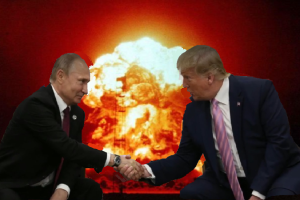














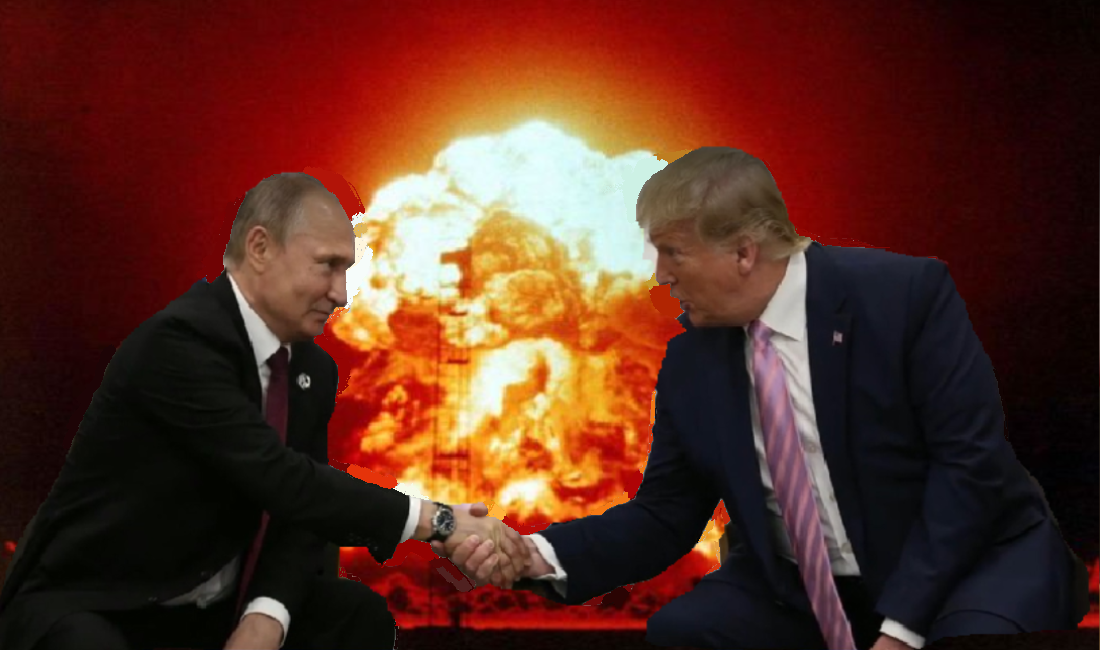
To secure Ukrainian peace, Russian President Vladimir Putin has demanded Britain and France withdraw their nuclear weapons umbrella over European allies. But he did not include the United States. Why?
It’s pointless for Putin to demand withdrawal of Britain’s and France’s nukes, without some assurance, implied, or perhaps through a secret pact, that Trump has already agreed to do the same.
European nations are already suspicious and panicked by President Trump’s waivering NATO support, a cornerstone of European peace since the end of World War II.
Putin’s demand, sans the United States, suggests he already has some level of assurance from Trump that the U.S. will refrain from a nuclear response, if Russia attacks Ukraine or Europe with tactical nuclear weapons.
A nuclear strike on Ukraine would be a quick way to end the war on Russia’s terms. Trump is also demanding a quick end to the war.
Assuring Putin of no U.S. response would pave the way for Russia to launch a nuclear strike to force Ukrainian capitulation.
Trump has clearly positioned the United States on the Kremlin’s side and racheted up pressure on Ukraine to force a peace settlement favorable to Putin.
And, the two leaders have had ample opportunities to discuss the matter. Trump has had one face-to-face meeting with Putin since returning to office and at least 14 publicly confirmed telephone calls. The topics are unannounced and no transcripts are kept of the conversations.
Because the White House and the Kremlin do not always release readouts for every conversation, the total number of calls may be higher.
In addition, U.S. Special Envoy Steve Witkoff has met with Putin ten times in person—several of which included Jared Kushner, Trump’s unofficial — and unvetted — envoy.
Kushner and Witkoff have pushed a compromise that would see Ukraine join NATO in exchange for ceding unconquered eastern Donbas regions to Russia. Zelenskyy has rejected the idea out of hand.
Trump raised a red flag himself when the U.S. abruptly withdrew all 12 of its strategic B-1 bombers from Britain in October.
Though framed as a move to thwart a suspected Iranian terror plot, the bombers would also have been a key part of a non-nuclear U.S response to a Russian attack. No other bombers are based on the continent.
The jets are now stationed in the contential United States and technically capable of reaching Russia through mid-air refueling.
Most visibly, the United States, likely in conjunction with Elon Musk, has hobbled Musk’s satellite-based Starlink/StarShield communication system. Ukraine relies the system for defense against Russian drone and missile attack on its cities.
The Trump administration, which cut off almost all funding for Ukraine, has also delayed or blocked the delivery of Patriot missiles that are critical to Ukraine’s defense, opening the country up to ballistic missile attacks.
Triump went further, effectively backstabbing Ukraine by funding Russia’s war effort to the tune of $4 billion though a sketchy deal to buy diesel fuel.
Trump twisted that knife hard by telling Ukraine to rid itself of President Vladimr Zelenskyy, who has successfully waged Ukraine’s defense against Russia’s invasion.
Shortly afterward, a report surfaced in Russian media that Putin had lifted an informal ban on killing Zelenskyy. That report remains unconfirmed by the Kremlin.
But two weeks after Trump’s comments (Oct. 26), former Russian President Dmitry Medvedev posted a message urging Trump to personally order the CIA and U.S. military to assassinate Zelenskyy, suggesting the Ukrainian leader is Trump’s personal enemy.
Kremlin officials have routinely praised Trump’s criticisms of Kyiv to drive a wedge between the United States and its European allies, portraying Zelenskyy as the sole obstacle to a U.S.-brokered peace. Trump, not suprisingly, has taken a similar stance.
Of course, there is no evidence the Trump endorsed Medvedev’s remarks or is coordinating with Moscow to target Ukrainian leaders. But the unfolding nature of the discourse is clearly how KGB-trained Putin operates.
What makes the absence of the United States in Putin’s statement noteworthy is the traditional role the United States has played in NATO.
Europe has relied on the United States’ nuclear umbrella to counter Russia. The continent’s only nuclear powers, Britain and France, have served as a backup nuclear deterrent.
Offically, the U.S. posture on its nuclear commitment to NATO is unchanged and bound by treaty obligations. But Trump has already shown countless times treaties and even laws are meaningless to him and routinely ignored.
Even more disconcerting, the President of the United States has the sole power to authorize — or withhold — a nuclear strike without any oversight or prior approval from Congress.
If Putin were to use a nuclear weapon against a Baltic state, Poland, Finland or Germany, Trump would have full authority to choose from a range of options, including a proportional nuclear strike, a massive conventional strike, or even a full strategic nuclear exchange—though the latter carries the risk of full-scale mutual destruction.
Or, he could do nothing at all.
Neither the United States nor Britain and France, for that matter, are obligated to come to the aid of Ukraine in the event of a nuclear strike on its territory.
For its part, the Biden administration, promised “catastrophic consequences” if Russia used nuclear weapons in the war, without saying precisely what the response would be.
Despite the strategic ambiguity in public, Biden signaled privately that a Russian nuclear strike would trigger a devastating non-nuclear conventional military response, which acted as a formidable check on the Kremlin.
Ironically, Communist China is currently the strongest deterrent to a Russian nuclear attack on Ukraine.
Both publicly and through private diplomatic channels, China has repeatedly warned Russia against using—or even threatening to use—nuclear weapons in Ukraine.
During Chinese President Xi Jinping’s state visit to Moscow in March 2023, China insisted on including language in their joint declaration stating that “a nuclear war cannot be won and must never be fought.”
Xi, Trump, and Putin are scheduled to meet on Thursday, November 19, 2026, in Shenzhen, China to discuss a range of matters, although Ukraine is not offically on the agenda.
Since launching the full-scale invasion of Ukraine in February 2022, Putin has repeatedly issued veiled and explicit nuclear threats aimed at deterring Western military aid to Kyiv and intimidating European nations.
In Nov. 2024, Putin signed an updated nuclear doctrine. It authorizes Russia to use nuclear weapons in response to a conventional attack by a non-nuclear state (like Ukraine) if that attack is supported by a nuclear power (like the U.S., UK, or France.)
The current situation on the ground in Ukraine a costly stalemate, and Russia is losing critical oil industry and other war-critical infrastructure to Ukrainian drones and cruise missiles at an alarming rate, narrowing the Russian President’s options.
Ukraine scored another devastating strike over the past two nights, taking out the Kerch Bridge, a symbol of Putin’s claim on Crimea and other parts of Ukraine.
As things now stand Putin’s demands were swiftly rejected by Nato’s 32 allies and Ukraine. Britain is likely to reject the demand not to extend its nuclear umbrella over its allies, according to European media reports.
The UK is the only European nation to commit its submarine-based nuclear deterrent to the wider defense of NATO.
“There was a very strong feeling that Russian demands to put the question of European security architecture or European security arrangements into this negotiation,” UK Prime Minister Andy Burnham told reporters.
“Well, no, that’s not up for negotiation. It’s for Europe to decide its own arrangements, Europe and Europe alone.”
Keith Girard has four decades of experience as an award-winning reporter, editor-in-chief, and senior media executive. Keith’s career began in Washington, D.C., where he was a reporter for The Washington Post and a contributing editor for Regardie’s and Washingtonian magazines. He also worked as a writer/producer in CNN’s Washington Bureau and has written non-fiction books on the U.S. Marines in the Gulf War and Donald Trump and two novels, “The Heidelberg Conundrum” and “The Curse of Northam Bay.”