










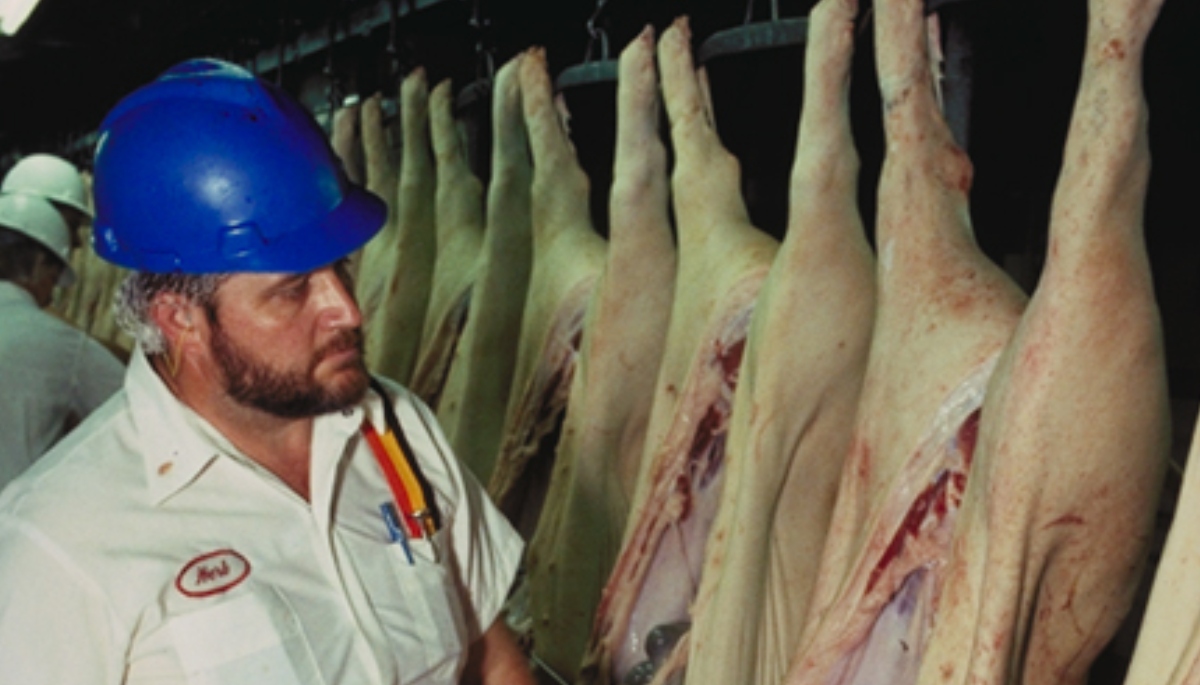
Donald Trump has ordered 176 million pounds of imported Argentine beef to lower record hamburger prices, at a time when federal food inspections have been slashed to historic lows and labeling laws have been gutted.
If, and when, the beef hits U.S. shores, consumers will have no idea what they are buying, according to cattle rancher Ben Spell.
“We import beef into the U.S. and it’s part of the system,” Spell explained on a recent episode of “The Clay Travis and Buck Sexton Show.”
But “in 2015 we repealed the mandatory country of origin labeling law for beef and pork, which means it can come from anywhere and it doesn’t have to say where it came from,” he said.
The U.S. imported more than “four billion pounds of beef” last year with no way of knowing the country of origin.
“The plate we eat on has to say what country it is from, but the beef, the food we buy, does not,” Spell said. “That’s a real problem.”
The potential problems with Argentinian beef were highlighted by a recent incident in China. The Chinese government in March rejected a 22-metric-ton (approximately 48,500 pound) shipment after traces of chloramphenicol, a banned antibiotic, were detected.
The drug has been widely banned for use in food-producing animals in most of the world—including the United States and Argentina since 1995—because it has been linked to a rare but serious human blood disorders and cancer.
Food safety should be paramount, but sweeping Trump administration personnel and funding cuts have caused U.S. foreign food safety inspections to drop to a historic low, according to a ProPublica investigation.
The administration cut roughly 20% of the FDA’s food and drug safety workers and eliminated 65% of the division staff responsible for managing travel and logistics for inspectors.
As a direct result of these logistical hurdles, physical foreign food inspections dropped by an estimated 30%. Foreign inspections are on pace to hit their lowest level since 2011. The agency is currently completing less than 10% of the annual inspections mandated by Congress.
Recently, nearly 30,000 pounds of raw Argentine beef were recalled after bypassing mandatory U.S. safety reinspections. Ranchers have also been hit by a screwworm epidemic in the Southwest after inspections and safeguards were gutted as well.
The administration has also reduced the number of federal government inspectors in meatpacking plants by up to 40%. Inspections are supposed to be now carried out by a plant’s employees while simultaneously dealing with increased processing line speeds.
Food safety experts said there’s an increased risk of outbreaks. “It’s only a matter of time before people die,” one said.
“This is the hill that we have been dying on since the beginning,” Spell said. “We want to connect the American family to the American farm.”
Meanwhile, American beef herds have fallen to a 75-year low.
“It’s not good,” Ben says. “I appreciate the president addressing the issue. Beef is way too expensive, and we need to do something about that.
“But flooding the market with more imported beef with no transparency doesn’t help the real problem. We have to rebuild the herds. We have to incentivize the ranchers who are responsible for doing that.”
Trump administration officials have tried to blame the Biden administration for declining herds, but Spell said the chief problem has been years of drought.
“The economic incentive has not been there for American ranchers. It takes fuel to run tractors…” Spell said. “You are talking about a two year process at minimum to rebuild a herd.”
The executive order specifically encourages importers to sell the foreign beef at 25% below current market value.
Artificially deflating prices on imports makes it impossible for domestic producers to compete, especially while they face soaring fuel and feed costs caused by Trump’s Iran war, ranchers argue.
A near monopoly over U.S. beef processing is also a bottleneck.
“Right now, 85 percent of the beef that is processed in the U.S. is owned by four major corporations. Two of those are foreign-owned. That in itself is problematic…”
Just like America strive to become oil independent after the gas price shocks of the 1970s, the U.S. needs to become food independent, and it starts with local farming, Spell said.
“If you read the history books, any time a nation loses access to their own food and has to be dependent on another country to feed them,” Ben says. “That is a problem.”
In a rare display of unity, four of the country’s largest agricultural and livestock organizations have signed a joint letter urging the president to reverse the 90-day import plan.
The groups are the National Cattlemen’s Beef Association (NCBA), the American Farm Bureau Federation, the United States Cattlemen’s Association, and the Livestock Marketing Association.
To address the crisis, Trump announced plans to draft executive actions granting ranchers “the right to process their own food,” allowing them to bypass USDA inspections entirely and sell their meat across state lines.
The Small Business Administration (SBA) is also making loans available to help U.S. cattle producers and small-scale, independent local slaughter facilities, and the USDA is opening up emergency grazing land to help ranchers recover from recent wildfires and forage shortages.
Check out the video below:
Keith Girard has four decades of experience as an award-winning reporter, editor-in-chief, and senior media executive. Keith’s career began in Washington, D.C., where he was a reporter for The Washington Post and a contributing editor for Regardie’s and Washingtonian magazines. He also worked as a writer/producer in CNN’s Washington Bureau and has written non-fiction books on the U.S. Marines in the Gulf War and Donald Trump and two novels, “The Heidelberg Conundrum” and “The Curse of Northam Bay.”