




















New York City will lose at least 42 additional Starbucks coffee shops in its ongoing war against the brand, as part of the company’s latest plan to slash 250 stores nationwide.
As far as the city administration is concerned… good riddance.
The City has been openly hostile to the chain and has been highly pro-labor, both during previous Mayor Eric Adams’ administration and now under current Mayor Zohran Mamdani.
In fact, Mamdani is urging his massive, 1-million social media followers to boycott the brand and seek out local, independent coffee shops.
Under Adams, the city’s Department of Consumer and Worker Protection (DCWP) forced Starbucks to pay $35 million to resolve claims that the company systematically violated worker protection laws. The city charged that Starbucks denied stable, predictable schedules to more than 15,000 New York City baristas.
Now, however, with about 240 remaining locations serving a population of roughly 8.3 million, the city that never sleeps will be woefully underserved compared to other cities.
The city averages about one Starbucks for every 34,500 people, compared to the national average of one store per 19,600 people.
In cities like Seattle, the brand’s home base, and Washington, D.C., the average is one store per 7,000 residents and 9,000 residents, respectively, according to industry estimates. Las Vegas and Portland also have more shops than New York City.
Within the city limits, the lion’s share of Starbuck’s outlets — 210 locations — are in high-income Manhattan. Measured against Manhattan’s 1.6 million population, store density equals the number of shops per capita in Seattle.
But middle class residential boroughs like Queens and Brooklyn have very few locations, despite immense populations.
Starbucks COO Mike Grams noted that the coffee giant did not publicly disclose a complete list of exactly which coffeehouses will close or a state-by-state breakdown. But large metropolitan areas are bearing the brunt of this restructuring wave, according to media reports.
Before successive corporate downsizings under a $1 billion corporate turnaround, New York City had as many as 350 coffee shops. Although Manhattan is losing 12% to 15% of its stores, high-profile flagship locations like the Starbucks Reserve Roastery New York in Chelsea and high-volume commuter hubs like Starbucks Union Square are safe.
The company has almost 36,000 stores in 80 countries; 15,873 are located in the United States.
Starbucks Chairman and CEO Brian Niccol, who is two years into the job, oversaw the closure last year of 627 stores in North America and Europe.
Grams said targeted locations either aren’t delivering acceptable financial results or can’t provide the kind of experience that Starbucks wants for customers and employees, according to The Associated Press.
The brand has been struggling with both a consumer backlash and employee unrest over efforts to unionize.
Niccol provoked a social media uproar when defended $9 coffee drinks He said the brand was focused on an “elevated café experience” for affluent customers who don’t mind paying premium prices. The company also started charging upwards of $0.80 for localized syrup or milk add ons.
Critics, particularly Gen Z and Millennials, said Niccol was deeply disconnected from average consumers dealing with rising inflation.
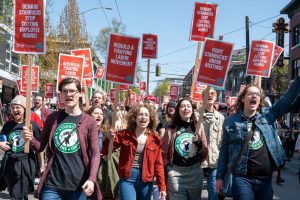
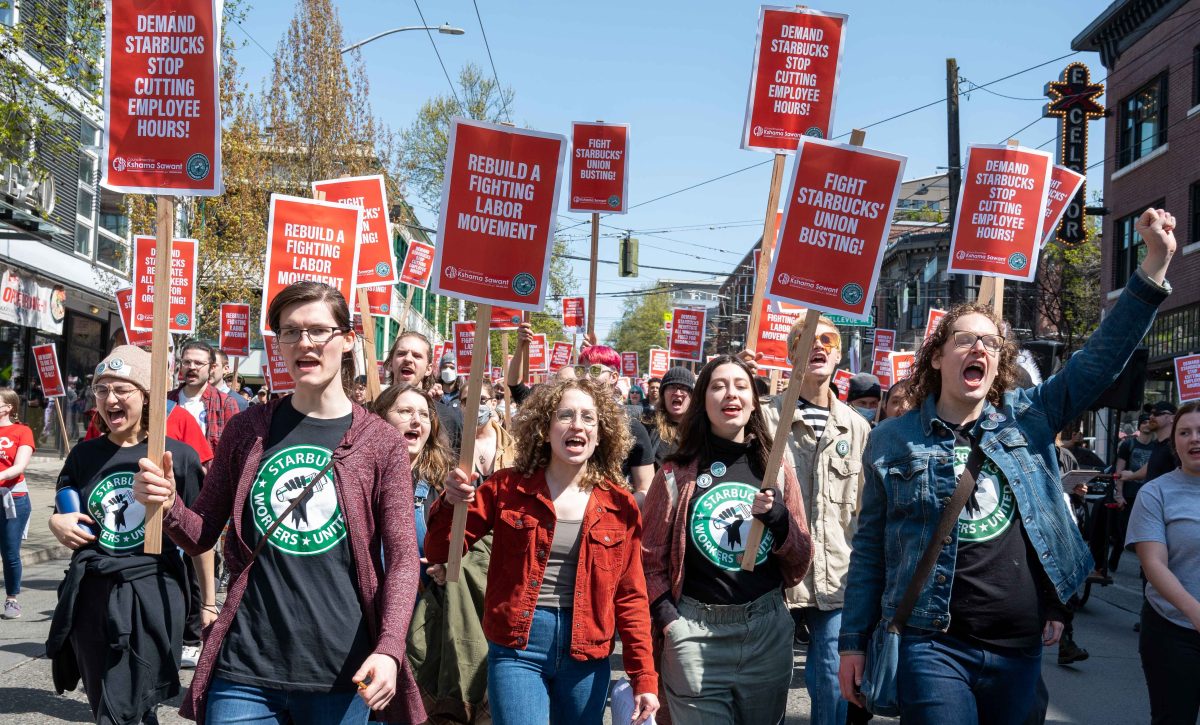
In August, Starbucks Workers United, representing over 12,000 baristas across more than 700 stores—formally launched a national consumer boycott, rallying around the slogan “No Contract, No Coffee.” The group is seeking a $17-an-hour minimum wage among other demands.
The company exacerbated tensions by suing the workers’ union over a social media post expressing solidarity with Palestinians.
Meawhile, the company has also come under fire in right wing states like Florida.
The state attorney general sued the company for allegedly violating the Florida Civil Rights Act by setting explicit racial and sex-based hiring quotas, offering preferential promotions, and tying executive compensation to meeting diversity metrics.
The company settled the suit and agreed to revises it’s so-called DEI policies and pay $1 million to cover the state’s legal cost. As it turned out, it may have conceded to pricipitously. A similar law suit was dimissed in federal district court in Missouri.
Images on this post are licensed under the Creative Commons Attribution-Share Alike 2.0 Generic license.
Keith Girard has four decades of experience as an award-winning reporter, editor-in-chief, and senior media executive. Keith’s career began in Washington, D.C., where he was a reporter for The Washington Post and a contributing editor for Regardie’s and Washingtonian magazines. He also worked as a writer/producer in CNN’s Washington Bureau and has written non-fiction books on the U.S. Marines in the Gulf War and Donald Trump and two novels, “The Heidelberg Conundrum” and “The Curse of Northam Bay.”