





















When thieves hit the Drents Museum in Assen, Netherlands, they used explosives to break in. They weren’t looking for paintings by the masters. The stole priceless ancient Dacian gold artifacts that could be easily fenced.
The theft last year is part of a growing trend in Europe involving a shift in tactics and targets, that could be troubling for U.S. Museums if the trend spreads here.
So far, U.S. museums have not reported a corresponding or similar trend of violent museum heists, but that could change as European nations heighten security and crack down on international crime rings.
More Reading: Met Returns Stolen Artifacts Amid Rising Global Thefts That Often End Up in Major Museums
The number of reported museum theft cases across Europe has been on an upward trajectory over the past two years, according to a report from Europol, which tracks organized crime, cybercrime and terrorism.
Criminals are increasingly moving away from hard-to-sell fine art paintings. Instead, they are targeting precious metals, gems, jewelry, and culturally significant artifacts.
Today’s thieves are using much more aggressive methods, including sledgehammers, axes, crowbars, and explosives to carry out thefts, similar to “smash and grab” tactics used by thugs to rob jewelry stores and specialty retailers.
The tactics may be a reflection of the fact that professional art theft rings are being replaced by loosely organized gangs, often recruited over social media.
More Reading: Plundered Nazi Art Finally Finding Its Way Home From Gurlitt WW II Horde
In another trend, smaller, regional museums that lack the sophisticated security systems of major institutions are being singled out.
Earlier this month (Sept. 8), thieves stole paintings by Pierre-Auguste Renoir from the Renoir Museum in Cagnes-sur-Mer, France. The house, where Renoir once lived, had been coverted into a museum in the 1960s, according to The New York Times.
The perpetrators broke in before 6 a.m. and pulled off the heist in less than three minutes, according to French police. In their haste to flee to paintings were dropped and left behind, Time magazine reported.
In the United States, the most recent significant theft occurred last October. More than 1,000 historic artifacts were stolen from an offsite storage facility of the Oakland Museum of California.
More Reading: Hildebrand Gurlitt, Notorious Nazi Art Thief, Surfaces in Art Probe
Police and the museum have deemed the theft a “crime of opportunity” burglary, not the work of an organized theft ring. Two thieves are believed to have pulled off the heist, and both are still at large, according to local police.
The stolen items include historic memorabilia such as political pins, award ribbons, and souvenir tokens, six Native American baskets, several 19th-century scrimshaw objects, and a number of daguerreotypes and modernist metalwork jewelry pieces. None are easily re-sellable, the museum said.
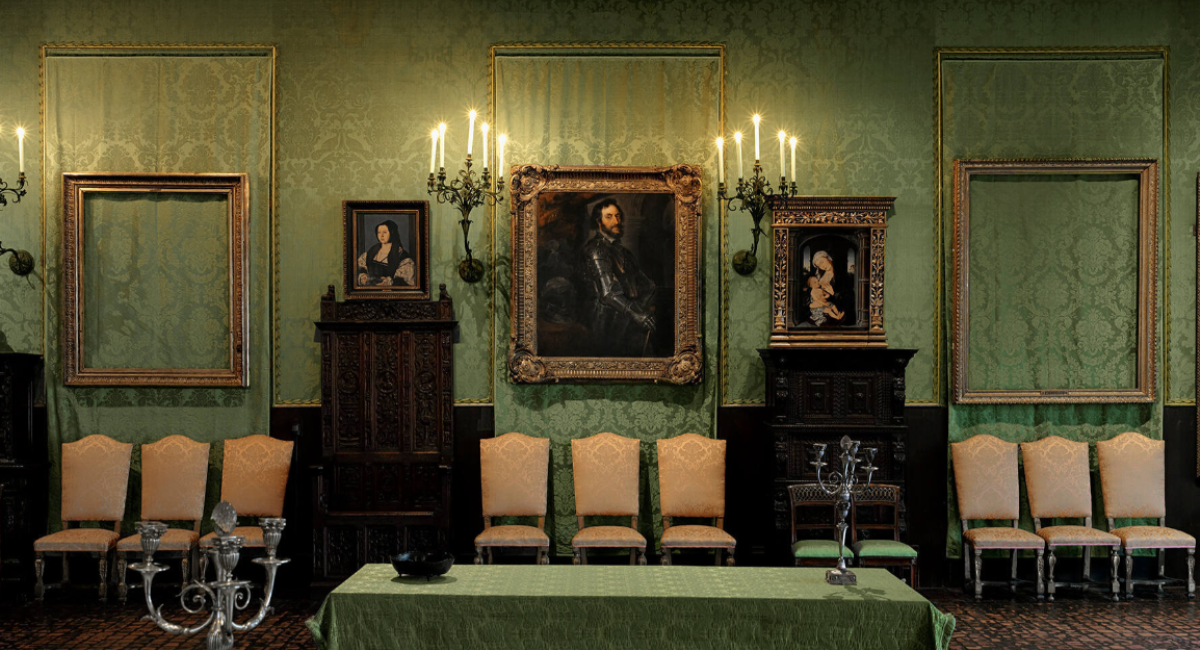
The last major art heist in the U.S. occurred 16 years ago in Boston, where 13 works worth an estimated $500 million were stolen from the Isabella Stewart Gardner Museum in Boston. The case also remains unsolved, and the museum is offering a six-figure reward for the return of the art works.
The theft had all the makings of a Hercule Poirot movie. Two thieves posed as police officers talked their way past two security guards after the museum had closed for the night. Once inside, they handcuffed the guards in the basement.
More Reading: French Art World Upended by Thefts, Museum Turmoil
The thieves took several well-known art works, including Rembrandt’s “Christ in the Storm on the Sea of Galilee” and “A Lady and Gentleman in Black.”
Also included in the loot were Vermeer’s “Concert,” a landscape by Dutch painter Govert Flinck, five works by Edgar Degas, Édouard Manet’s “Chez Tortoni” and a bronze eagle finial that belong to Napoleon.
The thieves left at 2:45 am. The guards remained handcuffed until police arrived at 8:15 am the same morning.
“The Museum’s commitment to recovering the stolen works has never diminished. The Museum, working closely with the FBI and the US Attorney’s Office, continues to seek facts that could result in the safe return of the art,” according to a statement.
Increasing media attention on European art thefts was spurred by the theft of Napoleonic era jewelry at the storied Louvre Museum in Paris.
Thieves broke into the Louvre and stole nine pieces of priceless jewelry at 9:30 in the morning, according to an Interpol report.
Four suspects, posing as construction workers, entered the museum’s Galerie d’Apollon (Gallery of Apollo) using a mechanical ladder mounted on a truck.
They broke through an upper-story balcony window using construction tools and cut through the display cases Among the items taken was a crown once belonging to Empress Eugenie of France, which the intruders dropped as they fled on Yamaha T-Max scooters along the Seine.
Police detained multiple suspects connected to the organized commando-style raid afterward through the use of physical evidence at the scene, plus DNA traces from abandoned gloves, a helmet, grinders, a blowtorch, and a walkie-talkie, the report stated.
Italy has also been hit by a series of recent art heists. The most recent case in August involves the Regional Interdisciplinary Museum of Messina in Sicily. Thieves were able to bypass alarms without triggering them.
Four Renaissance pieces—three panels of the Polyptych of San Gregorio and a double-sided panel of the Madonna with Child and Christ in Pietà—attributed to Antonello da Messina were stolen, according to the BBC.
Police suspect many of the recent incidents may be “copy-cat” thefts, spurred by the Louvre heist.
Interpol, short for International Criminal Police Organization, maintains a database of stolen artworks open to the public.

Keith Girard has four decades of experience as an award-winning reporter, editor-in-chief, and senior media executive. Keith’s career began in Washington, D.C., where he was a reporter for The Washington Post and a contributing editor for Regardie’s and Washingtonian magazines. He also worked as a writer/producer in CNN’s Washington Bureau and has written non-fiction books on the U.S. Marines in the Gulf War and Donald Trump and two novels, “The Heidelberg Conundrum” and “The Curse of Northam Bay.”