


Venezuelan President Nicolás Maduro in handcuffs aboard the USS Iwo Jima. (Photo: Government)
The Trump administration has offered a mish-mash of reasons for snatching Venzuelan dictator Nicolás Maduro, but only one seems to have legs — oil.
Trump has made clear that Venzuela’s oil is the prime reason for the U.S. military strike, but his promise to restore the Latin American nation’s oil industry and economy is a lose-lose proposition.
If the Venezuelan people are looking for relief from the Maduro regime’s poverty, shortages and political repression, they are also likely to be sadly disappointed.
More Reading: Trump Ignores Saudi Attack on U.S. Oil to Score Cheap Political Points on Gas Prices
Trump has shown no inclination to remove the Maduro government from power or end political repression at the hands of its security forces. He’s already endorsed Maduro vice president Delcy Rodriguez as the dictator’s successor.
But the country’s long term future has less to do with politics and everything to do with economics.
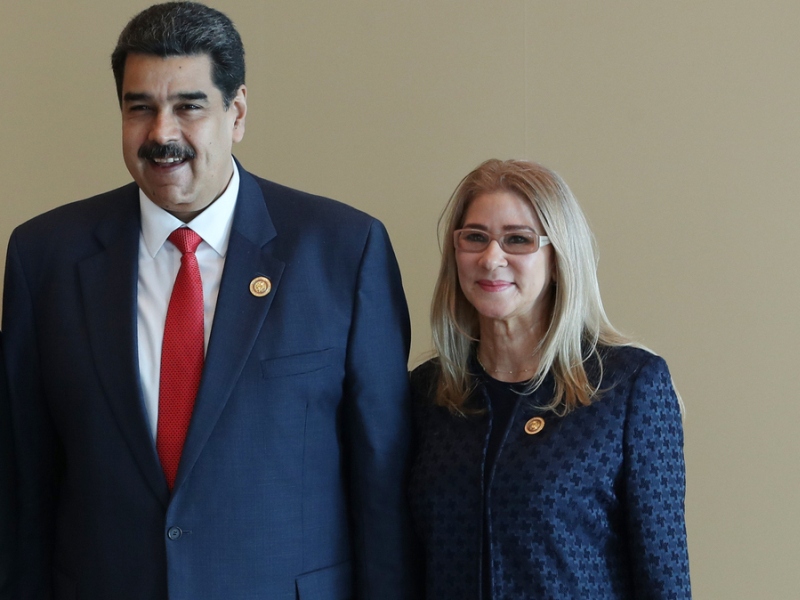
Nicolas Maduro and wife Cilia Flores in better times. Both are now in U.S. custody. Photo: Government)
The simple fact is the world is awash in oil right now. The price per barrel has fallen to 20-year lows and show no signs of reversing anytime soon in the face of weakening demand.
While demand pressure will weigh on the oil market going forward, today’s prices are being driven lower by excess production in the United States and the Middle East, primarily Saudi Arabia.
The Saudi government has been waging a price war for at least the last three years to regain market share, coming out of the pandemic lockdown, when it lost control of the global oil market.
Saudi Arabia, as the dominant force in OPEC+, wields significant power to reshape global oil markets, often acting strategically against U.S. interests, despite a cozy relationship with the Trump administration.
In this case, the Saudi oil strategy involves increasing production, not just to manage the market, but also to regain market share from U.S. shale producers and force higher-cost producers, including U.S. shale, to exit the market.
So far, it is succeeding. The Trump administration has yet to respond to the threat, choosing instead to score political points for lower prices at the pump. But U.S. oil companies are facing a day of reckoning.
More Reading: Donald Trump Oil Obsession, Rooted in the ’70s, Ignores Global Economics
U.S. oil companies generally struggle to stay profitable when prices fall below the $60-$70 per barrel range.
Shale oil, the most expensive to produce, is the dominant source of domestic crude, accounting for roughly two-thirds ( 64-70 percent) of total U.S. production, at a cost of $45 to $70 a barrel.
A sustained price at or below $50 a barrel makes most U.S. production unprofitable, forcing cuts potentially leading to well shutdowns and job losses, according to Morningstar.
Against that backdrop, Trump is touting a promised revival of Venezuelan oil production, which will only worsen the current supply glut.
Oil has been trading on world markets below $60 a barrel since October and shows no signs of rising. It’s trading around $58 today (Jan. 6).
More Reading: Trump Overseas: Not Only Disliked, But Fears He’s Selling Out Europe to Putin
While Venezuela boasts the largest oil reserves in the world — about 300 billion barrels –much of it is heavy and extra heavy crude, which has high extraction and refining costs.
To profitably exploit the nation’s oil reserves, prices need to be at least a sustained $70 a barrel, not counting the huge mult-billion dollar cost of rebuilding it’s decayed oil infrastructure to reach its once peak production of three million barrels a day.
The cost to restore production ranges from $10 billion to $20 billion annually for a decade, or up to $100 billion for significant revitalization, with some analysts suggesting $180 billion to $200 billion for full transformation.
Trump has boasted that oil production can be restored in 18 months, but experts say his estimate has no basis in reality. More likely, expderts say it would take $10 billion a year over the next two years to boose production by 500,000 barrels daily.
Venezuela currently produces about one million barrels daily, or about 1 percent of world production, and most of that is currently sold to China in the face of U.S. sanctions. Trump says he won’t disrupt Chinese sales for good reason.
More Reading: Trump ‘Golden Age’ Turns Ugly; Lies, Corruption, Excesses, Epstein Scandal Tarnish Presidency
Oil revenues prop up the Venzuelan government. Historically, oil revenue funded nearly two-thirds of its budget and made up more than 90 percent of its export earnings.
Even with diminished production, oil revenue in 2023 covered around 58% of the state budget, or about $6.2 billion from the state oil company PDVSA.
Trump’s main interest is protectng oil company investment, not in improving living standards in Venezuela.
While slowing economic activity has contributed to the softness of oil prices, other long-term trends will impact oil demand and Venzuela’s future going forward.
Chief among them is the steadily growing market share of electric vehicles (EV). Nearly half of all refined oil is made into gasoline for internal combustion engine (ICE) cars and trucks. But that market is slowly eroding.
More Reading: Trump Treason 101: Was He Funneling Nuclear Weapons Technology to the Saudis?
The electric car industry is a solid-state battery away from exploding into a dominant form of transportation. Current lithium-ion battery technology limits range and raises safety concerns.
Solid state batteries are infinitely safer, and some experimental batteries are capable of boosting range up to 1,000 miles between charges. Commercial availablity is only a few years away.
Even so, EV sales still account for almost 18 percent of all vehicle sales globally and just over 10 percent of sales in the United States. Each EV cuts gasoline usage by up to 500 gallons a year on average.
The next largest market for oil — heating homes and businesses — peaked decades ago (1970s/1980s) and continues to fall as the market switches to natural gas, electricity, and heat pumps, according to the U.S. Energy Information Administration (EIA). That market makes up about 28 percent of crude production.
Expectations are sky high right now in Venezuela that the 26-year reign of terror at the hands of the Chavista dictatorship is coming to an end. But nothing Trump has done so far, guarantees that the end is near.