









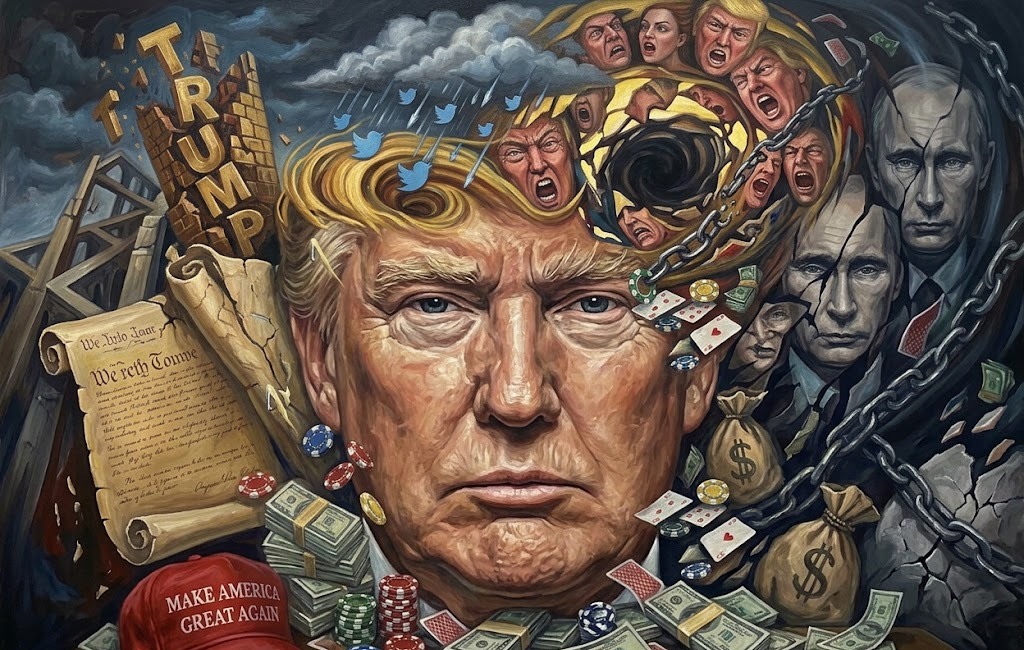
Donald Trump has had his fair share of successes over his long career, and therein lies the paradox.
Every achievement — whether it’s building Trump Tower, or casinos in Atlantic City — has been followed by an intense period of compulsive, self-indulgent, destructive behavior that pushed him to the brink of ruin.
Trump may be going through another cycle now, with far more consequences for the nation. His presidency is teetering on the brink of collapse politically, largely through his increasingly impulsive and dangerous behavior.
Self-destructiveness is primarily driven by a person’s attempt to cope with overwhelming emotional distress, unresolved trauma, and core beliefs of unworthiness,” according to academic studies.
Deep-seated feelings of worthlessness, guilt, and shame heavily drive self-sabotage, according to insightspsychology, a mental health practice in Minnesota.
If an individual holds an unconscious belief that they are inherently flawed or ‘bad,’ they may engage in self-destructive acts as a form of self-punishment. For instance, a person might ruin a good relationship, job opportunity, or financial standing because they feel they do not deserve success or happiness.”
Oftentimes, self-destructive behavior can be traced to childhood through abuse, an unresolved past trauma, or chronic childhood neglect. Clinical psychologist and niece Mary Trump has written extensively about Donald Trump’s childhood trauma and family upbringing.
Grandfather, Fred Trump Sr., was a high-functioning sociopath, she writes, who divided the world strictly into winners and losers. In this environment, showing vulnerability, kindness, empathy, or weakness was treated as dangerous and unacceptable.
Donald’s father subjected older brother, Fred Jr. (Freddy) to intense criticism and showed little respect for him. To avoid a similar fate, Donald adopted his father’s hard, aggressive, and bullying persona. Fred Jr. was only 42 when he died of a heart attack related to alcoholism.
Trump’s upbringing was so turbulent, his parents shipped him to the New York Military Academy (NYMA), a private boarding school in Cornwall-on-Hudson, NY, when he was just 13-years-old. He stayed there until he graduated high school in 1964.
As the priviledged son of a wealthy real estate developer, Trump was handed opportunities which he squandered, and that became a pattern he repeated over and over again.
He was able to transfer from middling Forham University to the Wharton School at the University of Pennsylvania through the intervention of his brother, whose friend worked in the admissions office. But once there, he treated his studies cavalierly to the point one of his professors described him as the worst student in his teaching career.
Trump often brags that his father only staked him to a $1 million loan to launch his own real estate career, but The New York Times, citing financial records, reported in 2018 that Fred’s largess toward his was more on the order of $413 million, mainly through tax fraud, over the course of his life.
It’s well known and was widely reported during Trump’s early years in real estate that he was driven to succeed and chased celebrity with unprecedent zeal, even masquerading as a public relations agent to promote himself.
But even back then, almost every success was followed by significant failure. His signature achievement, Trump Tower on Fifth Avenue, was completed in 1984. But a string of disastrous deals followed; all three of his casinos in Atlantic City, plus his entertainment company went bankrupt.
He lost the Plaza Hotel to bankruptcy as well, and was forced to sell at distressed prices his airline, Trump Shuttle, his mega-yacht, Trump Princess, and lucrative undeveloped rail yards on Manhattan’s West Side, all in the space of three years.
He was forced to pivot to real-estate branding licenses after banks refused to loan him money. But even some of those deals went south, notably Trump International Golf Club Puerto Rico, and two Trump Towers projects in Florida.
Paul Krugman, a Nobel Prize winning economist, says it’s a well-understood proposition that business owners who are on the verge of going bust often engage in destructive behavior.
Of course, the other half of the paradox is Trump’s uncanny ability to reinvent himself. When no major banks would lend him money, Trump raised cash through up-front fees for Mar a Lago memberships and later golf memberships.
Deutsche Bank, later accused of laundering Russian money, became a primary lender when almost no other major wall Street banks would do business with him. Donald Trump Jr. bragged (and later recanted) about getting financing directly from Russia.
Then, in 2004, he was tapped to star in a new reality show, “Celebrity Apprentice,” which was a signifcant hit and helped rehabilitate his reputation as an astute businessman.
His first presidential run in 2016 was not expected to go anywhere, but Democratic opponent Hillary Clinton’s campaign imploded after internal emails were leaked ostensibly by Russia, and FBI Director James Comey announced the reopening of an investigation into her private email server just 11 days before the election.
Trump won in a surprise victory, but true to the paradox, he effectively destroyed his re-election chances by mishandling the COVID epidemic. A major series of gaffs that culminated in the Jan. 6 storming of the U.S. Capitol.
Trump’s downward spiral continued with his indictment in four separate criminal investigations including his conviction on 34 felony counts for misuse of business records to pay $150,000 to porn star Stormy Daniels to cover up their affair (which he denies).
With the three other cases hanging over his head, Trump ran for re-election and fate intervened again. Democratic opponent Joe Biden suffered a massive meltdown during their sole presiential debate and was replaced on the ticket by his vice president Kamala Harris, who proved to be personally unpopular. Trump won again.
By 2024, despite Trump propaganda, the Biden administration economy recovered faster than any industrial nation and ended the year with low inflation, strong job recovery and low interest rates.
By all rights, the economy should have kept on rolling, despite a change in administrations. But Trump tariffs, his wildly erratic policies and alienation of key allies like Canada, Mexico, NATO and the European Union racheted up consumer anxiety.
The illegal invasion of Iran was the body blow that knocked the wind out of the consumer confidence, caused inflation to soar, led by gas prices, and cloaked the nation in a gloomy realization that Trump is single-handedly self-destructing before the all important midterm elections.
Trump, however, had set himself up for failure from the outset by making grandiose campaign promises that would be next to impossible to carry out. His signature policy, high tariffs backfired, sending consumer prices higher.
Trump’s unprovoked sneak attack on Iran has led to a seven-month standoff leading into the midterm elections. His betrayal of Ukraine and pause in Russian sanctions under the Graham bill and his preicpitous fall into Russia’s orbit, has damaged him further.
Now, Trump is about to go bankrupt — not financially (he’s made billions through corruption) but politically. So he, like a failing businessman, has strong incentives to wreak havoc, Krugman notes in his latest substack column.
Robert Pape, author of the substack “Escalation Trap” makes a similar argument. He notes a particular form of moral hazard — often called “gambling for resurrection.”
” When a company is on the edge of failure, it makes sense for the company’s owner to make highly speculative, even crazy investments that are highly likely to fail but might, just might, make enough money to pull the company back from the brink. After all, for the owner it’s heads he wins, tails his creditors lose,” he writes.
While a normal president might be able to live with a Congress controlled by the opposing party, there has been so much corruption and malfeasance over the past two years that Democratic control of Congress, and the subpoena and investigative power that will bring, will have catastrophic consequences for Trump and everyone around him, according to Krugman.
Trump has clearly entered the self-destructive phase of the paradox, which could trigger actions that will harm not only himself, but the nation as a whole.
“A president who cared at all about what is good for America wouldn’t pursue disastrous policies for the slim chance of saving his own political skin. But this is, after all, Trump we’re talking about,” Krugman writes.
“Trump’s impending political bankruptcy will have even worse consequences than Pape suggests — and that these consequences will continue and intensify after the midterms.”
The worst case scenario is an attack on the Constitution and American democracy itself in an attempt to reverse the outcome of the elections.
If the nation reaches that crossroads… there’s no telling how far he will go, or how the nation will respond.
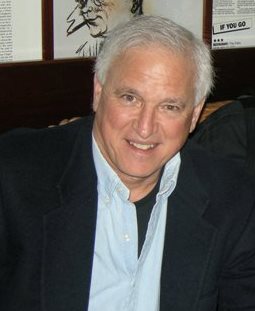
Keith Girard has four decades of experience as an award-winning reporter, editor-in-chief, and senior media executive. Keith’s career began in Washington, D.C., where he was a reporter for The Washington Post and a contributing editor for Regardie’s and Washingtonian magazines. He also worked as a writer/producer in CNN’s Washington Bureau and has written non-fiction books on the U.S. Marines in the Gulf War and Donald Trump and two novels, “The Heidelberg Conundrum” and “The Curse of Northam Bay.”