






















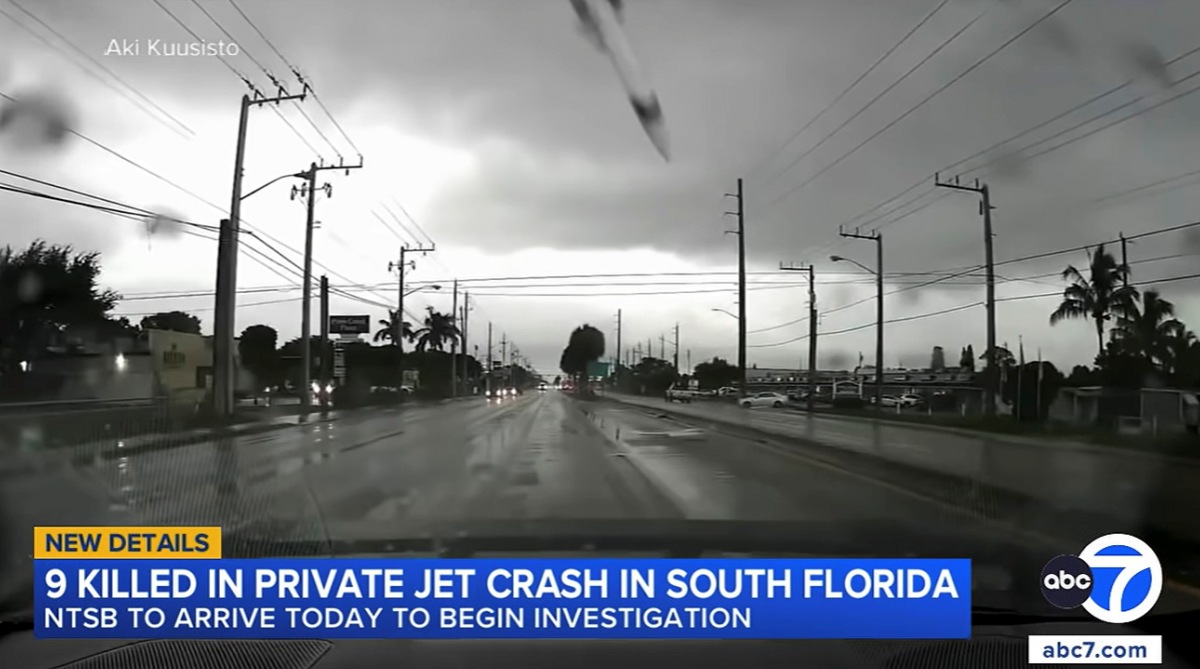
A Learjet 60 private plane that crashed horrifically in Florida was likely cruising normally until it suddenly snapped in a steep 60-degree bank and uncontrollable dive that was impossible to recover from, according to a preliminary analysis of the tragedy.
Tech tycoon Adam Robinson, 45, and his wife Helen Sharp, 40, their nanny, two friends, and their two children died instantly along with the pilots when the jet thundered into the ground doing an esimated 580 miles per hour.
Because the plane was cruising at a high altitude for nearly two hours, the transition from a smooth, quiet flight to a catastrophic emergency would have been instantaneous, terrifying, and unmistakable to the passengers.
The plane would have violently pitched nose-down and rolled up to 60 degrees on its side. Passengers would have experienced a sudden sensation of weightlessness (negative Gs) followed by immense downward crushing forces as the plane entered its spiral.
As the aircraft rapidly accelerated past its maximum safe speed (overspeed), the sound of the wind rushing past the fuselage would have become deafening. The plane would have begun to vibrate violently due to aerodynamic flutter and structural stress.
Loose items — laptops, phones, drinks, luggage—would have been violently thrown around the cabin Robinson and his family would have been thrown against their seatbelts or the sides of the aircraft as the jet tilted steeply and hurtled toward the ground.
For the first 30 seconds, the passengers would have felt the initial violent drop from 35,000 feet and heard the cockpit warning alarms blaring.
As the jet plummeted at a catastrophic rate exceeding 20,000 feet per minute in the final 60 seconds, the ground would have been visibly rushing toward the windows at an impossible speed and they would have known they wouldn’t survive.
The plane disintegrated instantly upon hitting the ground, including the passengers and crew. Everyone would have died instantly without feeling any pain upon impact.
Scientists have discovered that the human brain requires roughly 100 to 150 milliseconds just to recognize a sensory stimulus, and slightly longer for pain. At it’s estimated speed at impact, the occupants would have lost consciousness in less than 5 to 10 milliseconds.
Although pilot Jeff Gregory, 55, and s co-pilot Nathalia Filgueiras, 20, were experience in the business jet, they appear to have been caught off-guard when it entered into a so-called ‘”estreme high-altitude upset,” essentially a stall and sudden loss of control of the aircraft.
The situation appears to have become largely unrecoverable for the crew, once severe overspeed, and a potential structural separation of its T-tail/horizontal stabilizer occurred seconds after the stall.
Descending at rates scaling up from 10,000 feet per minute to over 20,000 feet per minute left the two-pilot crew only about 90 seconds from the onset of difficulties to ground impact, leaving no time or altitude to re-establish control once structural or severe aerodynamic loss occurred, according to an artificial intelligence analysis of the crash.
The aircraft became susceptible to a stall when it reached its high-altitude limits, a situation known to pilots as the “coffin corner.”
A Learjet 60 operating at high cruise altitudes (around 35,000 to 41,000 feet) has a very narrow margin between its stall speed (flying too slow) and its critical overspeed limit (flying too fast).
The jet’s T-tail configuration — with the horizontal stabilizer and elevator mounted at the top of the vertical fin, away from the fuselage –is also susceptible to a distinct and dangerous condition during high-altitude upsets, stalls, or severe icing conditions.
While this design offers high aerodynamic efficiency during clean, cruise flight, it’s also capable of stalling before the wing, a situation known as a deep stall or super tall.
At a high angle of attack (when the nose is pitched up sharply), the turbulent, stalled airflow from the main wings and engine nacelles flows directly backward and envelopes the high-mounted T-tail. The horizontal stabilizer loses virtually all aerodynamic airflow.
The elevator becomes completely useless, leaving the pilot with zero pitch authority to force the nose down, trapping the aircraft in a steep, unrecoverable descent.
The pilot reported some light icing on the aircraft as it ascended to 40,000 feet creating another potentially dangerous condition. T-tail icing creates creates a dangerous paradox regarding how a pilot must recover.
A horizontal tail plane generates downward lift to keep the nose of the plane up. When ice disrupts airflow over the tail, the tailplane stalls—losing its downward force.
Most pilots train extensively for a wing stall, when air moves over the wing too slowly to support the plane. The standard procedure is to push the nose of the plane down to regain airspeed.
But a tailplane stall causes the tail to stop pushing down, resulting in a sudden, violent, uncontrollable nose-down pitch.
If a pilot mistakenly applies standard wing-stall recovery (pushing the yoke forward), they will worsen the tail stall. Recovering from a tailplane stall requires pulling back on the control column to change the airflow angle over the tail.
It’s unknown at the moment how Gregory, and co-pilot Filgueiras reacted initially or even if they were aware of the situation before it was too late. The aircraft can feel perfectly stable right up until it encounters an outside disturbance, like icing or turbulence.
A main wing stall gives pilots plenty of physical warnings—such as aerodynamic buffeting, a shaking control stick, and a falling airspeed indicator. But a tailplane stall happens silently.
Because the T-tail is mounted far back and high above the fuselage, the turbulent air breaking off an iced-up tail doesn’t shake the cabin or the cockpit controls like a wing stall.
The transition from normal flight to a high-altitude stall can happen in a split second.
In many tailplane stalls, the aerodynamic forces on the elevator change so drastically that the control column will physically and violently violently slam forward, ripping itself right out of the pilot’s hands.
By the time the pilot realizes the aircraft is losing performance, it may have already entered the critical angle of attack where the T-tail is blocked and no longer functioning.
In the cold, thin air at high altitudes, jet engines produce significantly less thrust, making it much harder to simply “power out” of a dangerous loss of speed. It’s also likely neither pilot had actually physically experienced how a T-tail behaves.
If a tailplane stall is caused by icing, the symptoms are completely counterintuitive.
If the pilot assumes the sudden drop is a standard high-altitude wing stall and pushes forward (or even just relaxes aft pressure), they actively increase the airflow malfunction over the tail.
This locks the aircraft into a steep, high-speed dive, making recovery nearly impossible before they realize they need to pull back instead.
Once a T-tail aircraft enters a deep stall, pushing the stick forward is completely ineffective because the elevator is sitting in a “dead zone” of stalled air.
To restore airflow over the tail — and control — a pilot conceivably could jockey engine thrust to create a pitch-down angle or turn the wings into a steep bank to change the angle of attack and move the T-tail back into clean air.
But it would take almost an instantaneous reaction by the pilot to make those maneuvers, and there is evidence to suggest the high T-tail was damaged by extreme aerodynamic flutter.
Evidence suggests that the flight was uneventful until the pilots encountered a looming storm cell along their route over Florida. Standard procedure is always to fly around it, rather than attempting to climb above it.
Trying to out-climb a severe thunderstorm is widely considered a catastrophic mistake for several critical reasons. Thunerstorms are explosive in nature and can shoot upward faster than any private jet can climb, often reaching 50,000 to 60,000 feet.
Attempting to climb over an exploding storm cell can trap an aircraft at high altitude where performance is already strictly limited by its coffin corner. If a pilot tries to climb above a storm, it can hit severe updrafts or high-altitude icing.
The Learjet pilots initially attempted to fly around the thunder cells, but then attempted to climb above the worsening weather right before losing control, according to air traffic control recordings and the preliminary National Transportation Safety Board (NTSB) briefing.
The plane initially descended from 41,000 feet to 35,000 feet to get around the storm cells. But Filgueiras radioed encountering moderate turbulence, light ice accumulation, and increasing precipitation at 35,000 feet.
To escape the ice build-up and weather, the crew requested a climb back up to 37,000 feet, likely in an attempt to climb above or pierce through the top layers of that specific storm system.
The aircraft’s attempt to climb to 37,000 feet put them directly into the worst of the high-altitude icing and aerodynamic trap, according to The Miami Herald.
Less than 30 seconds later, the aircraft entered a terminal, high-speed dive. The crew declared an emergency, reporting an extreme overspeed condition and a descent rate exceeding 20,000 feet per minute before the fatal impact.
Keith Girard has four decades of experience as an award-winning reporter, editor-in-chief, and senior media executive. Keith’s career began in Washington, D.C., where he was a reporter for The Washington Post and a contributing editor for Regardie’s and Washingtonian magazines. He also worked as a writer/producer in CNN’s Washington Bureau and has written non-fiction books on the U.S. Marines in the Gulf War and Donald Trump and two novels, “The Heidelberg Conundrum” and “The Curse of Northam Bay.”