

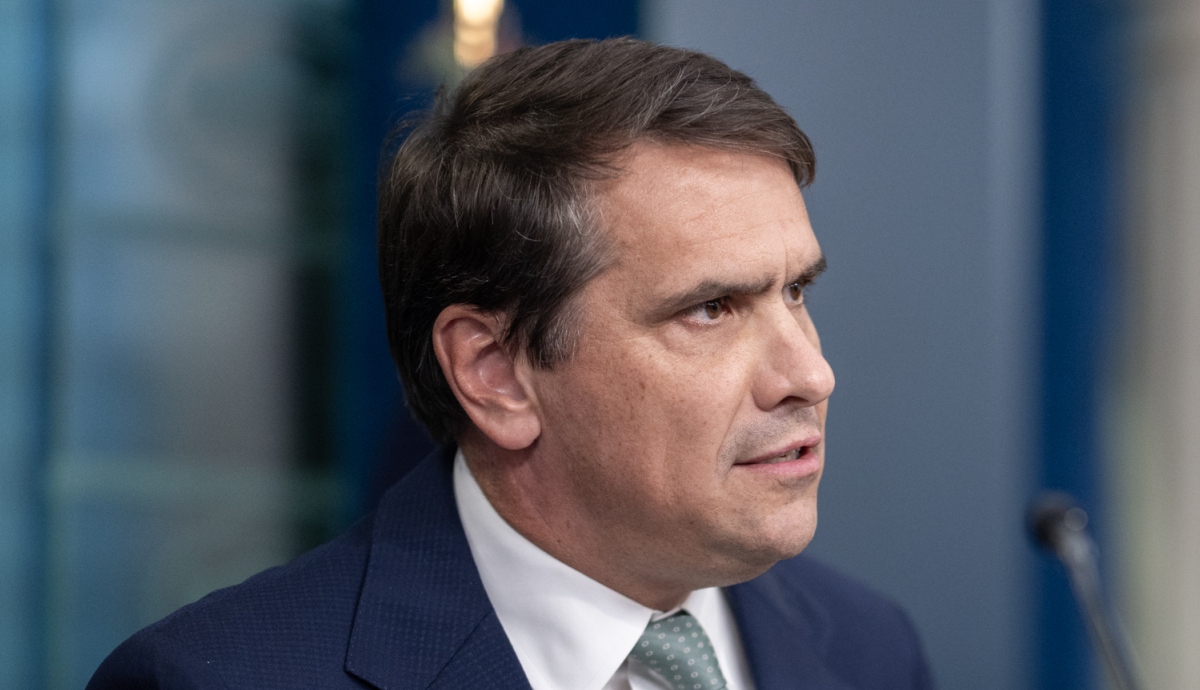
Todd Blanche’s nomination as U.S. Attorney General could be derailed in New York disciplinary hearings. (Official White House Photo by Molly Riley)
Todd Blanche’s Attorney General nomination could get hung up on a judge’s recommendation for disciplinary action before legal authorities in New York — one of a slew of ethics complaints he’s facing here.
Blanche’s license to practice law is registered and on file with the New York State Unified Court System, which handles lawyer complaints through several regional Attorney Grievance Commissions.
The New York City Bar Association, which is separate from the state bar, has already opposed Blanche’s nomination, calling him “unfit” for the office.
In a scathing court ruling, U.S. District Judge Kathleen Williams accused Trump, Branche and Associate Attorney General Stanley Woodward of attempting to manipulate the court system over Trump’s lawsuit against the Internal Revenue Service (IRS).
Williams referred Blanche to the New York bar for disciplinary action and Woodward to the D.C Bar Association. Should Blanche be disbarred or disciplined, it would not prevent him from serving as Attorney General.
The U.S. Constitution and federal law establish no formal qualifications for the job. Conceivably, a non-laywer or disbarred lawyer could be appointed. But no one like that has served as Attorney General in the nation’s history.
It’s also doubtful a disgraced lawyer could pass muster during the Senate confirmation process, but Blanche conceivably could test that assumption.
Aside from Williams’ referral, Blanche is facing sweeping ethics complaints in New York.
More than 100 former federal and state judges filed a 69-page ethics complaint, accusing Blanche of violations of the New York Rules of Professional Conduct. It charges conflicts of interest, attempting to assist the President in settling a private tax audit, politicizing the Department of Justice to harass political opponents, and mishandling the Jeffrey Epstein files.
The Campaign for Accountability, a nonpartisan, nonprofit watchdog organization, asked the Attorney Grievance Committee of New York’s First Judicial Department — and the Committee on Grievances for the Southern District of New York — in May to investigate Blanche for his role in the prosecution of Kilmar Abrego Garcia.
In June, the Campaign also filed a complaint with the DC bar against Woodward, the sole signer on the Trump settlement, for violating ethics rules governing conflicts of interest. As Associate Attorney General, Woodward’s tenure is governed by a separate law, and disbarrment or disciplinary action could cost him his job.
“By refusing to allow President Trump’s fictional settlement to undermine the legitimacy of the courts, Judge Williams stood up for the rule of law. Now the DC Bar must follow suit,” said Campaign Executive Director Michelle Kuppersmith in a statement.
For his part, Blanche told a Federalist Society event earlier this year the department was at “war” with state bar associations. He vowed to curb their oversight powers and hire outside counsel to fight disciplinary actions against DOJ lawyers, according to the Democracy Docket, another non-partisan group.
The crux of Blanche’s problems involves a lawsuit filed on Jan 29 by Trump, Donald J. Trump Jr., Eric Trump, and The Trump Organization, LLC. They were seeking $10 billion from the IRS and Treasury Department for allegedly failing to prevent a leak of the president’s tax returns to news outlets between 2018 and 2020.
Last May, Blanche settled the suit without arguments ever being filed, granting Trump immunity from all tax audits now and in the future and establishing a $1.776 billion fund to compensate Trump allies who believe they were unjustly persecuted by the Biden administration.
Woodward was the sole signer of the settlement agreement “notwithstanding his prior representation of multiple clients whose interests are directly and substantially implicated by the matters resolvedin that settlement,” the campaign for accountability argued in an ethics complaint to the D.C. Bar.
The suit raised red flags because Trump was suing “entities whose decisions are subject to his direction,” according to court records.
Williams nullified the settlement agreement and lambasted the government and president’s lawyers for using the judicial process to try to concoct a beneficial arrangement for the president.
“Acting Attorney General Blanche’s apparent capacity to speak for both Plaintiffs and Defendants, sign a ‘settlement’ document on behalf of all Parties to this action, and then repudiate part of that agreement, demonstrates that there was only one party whose interests were being represented throughout this case,” the judge wrote in her scathing opinion.
“The court finds that this matter was brought for an improper purpose – to gain the imprimatur of judicial legitimacy for a ‘settlement’ that had no viable basis in law or fact,” she added.
The New York City Bar cited Blanche’s “lack of commitment to the integrity, professionalism and independence” during his tenure as Deputy Attorney General and as Acting Attorney General.
The bar charged that Blanche’s “primary loyalty” is to Trump and not the Constitution or the “rule of law.”
The organization specifically cited his abuse of the Department’s prosecutorial power through politically motivated prosecutions and investigations; failure to respect the Constitutional rights of citizens protesting widespread abuses by ICE and other customs officers and his handling of the Trump lawsuit.
Blanche’s termination or reassignment of department lawyers who participated in the Jan. 6 riot investigation also underminded the independence and integrity of the Department of Justice
“Under normal circumstances, each of these improper actions by Mr. Blanche as Deputy Attorney General and Acting Attorney General would be grounds for disqualifying him from serving as Attorney General,” the bar’s letter stated.
“Together, they demonstrate that, whatever his prior experience or formal credentials, Mr. Blanche is unfit to lead the U.S. Department of Justice.”