








A new Trump Treasury Department rule that shields millions of shell companies from disclosing their owners is facing a court challenge over it’s legality by 21 state attorneys general.
The lawsuit seeks a court order declaring the Treasury Department’s rule unlawful and preventing it from being implemented.
Shell companies are widely used by money launderers, drug traffickers, and criminal organizations to hide their activities and no one takes advanage of them quite like Donald Trump.
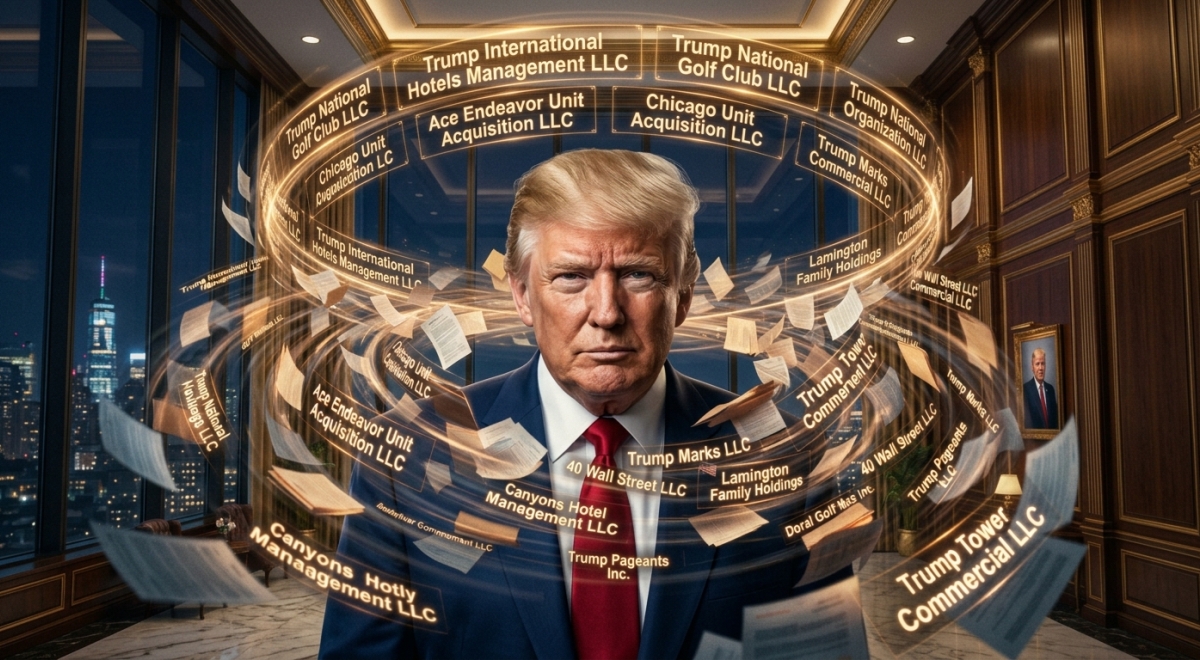
His umbrella company, The Trump Organization, includes an estimated 500 to 770 distinct corporate structures and Limited Liability Companies (LLCs) to manage real estate assets, license names, hold stakes in other businesses, or provide legal and tax protection, according to disclosures.
Dozens of financial companies, hedge funds and banks also use shell companies extensively.
Goldman Sachs has an estimated 900 offshore entities that managing localized investment funds, isolate trading risks, and establishing special purpose vehicles. A conglomerate like Warren Bufett’s Berkshire Hathaway has more than 800 separate companies.
A key difference is the Trump Organization’s structure. Hundreds of entities are overwhelmingly tied directly to the holdings, names, and real estate assets of a single individual and his immediate family. The Trump companies are rife with conflicts of interest to his duties as president.
In 2021, Congress passed the Corporate Transparency Act (CTA) to crack down on secretive shell companies that disguise their owners’ identities. The measure requires domestic and foreign companies to report information on their owners to the Treasury Department.
The Trump administration has effectively overturned this law by enacting a rule that exempts all domestic companies and U.S. owners of foreign companies from the law’s requirements, allowing the true owners of both foreign and domestic shell companies to remain anonymous, according to the coalition.
New York Attorney General Letitia James and the coalition argue that this rule undermines law enforcement investigations into criminal organizations and prevents states from collecting taxes by allowing shell companies to shield funds from authorities.
In their lawsuit, the coalition argues the Treasury Department rule is illegal and unconstitutional, and seek a court order preventing it from being implanted.
“Secretive shell companies help drug traffickers, tax cheats, and other criminals hide their illegal profits,” said James in a statement.
“The Trump administration is gutting a critical federal law that forces these companies out of hiding and helps law enforcement track down stolen funds. Today, we are taking action to uphold the law and ensure that criminal networks cannot abuse the system to hide their activities.”
Shell companies typically have no physical presence beyond a mailing address, no employees, and produce nothing.
Networks of shell companies are often used to conceal their owners’ finances and identities, making them popular tools for money launderers and other criminals.
Shell companies are also commonly used in tax evasion, financial fraud, and other crimes, and are key components of funding networks for terrorism, drug and human trafficking, and political corruption.
The law in question requires the Financial Crimes Enforcement Network (FinCEN) within the Treasury Department to collect ownership information on corporations that may be shell companies and make it available to state and federal law enforcement.
In 2024, the first year that CTA was implemented, millions of corporations reported information about their owners to FinCEN. At that time, the Treasury Department estimated that approximately 32.6 million companies would be covered under the law, with about five million new eligible companies formed every year.
But the Trump administration’s Treasury Department issued a rule to completely undermine CTA’s effectiveness.
The rule exempted all domestic companies from disclosure requirements and allowed all foreign companies to decline to identify any U.S.-based owner.
The rule effectively overturns the law by exempting nearly every company that would be covered.
More than 99.9% of all corporations are now exempted that would have beene subject to the reporting requirements, according to General Acccounting Office (GAO) estimates,
The Treasury Department also announced in its new rule that it will delete the information it has collected on companies that are now exempted, despite lacking legal authority to do so.
Yet, the Treasury Department’s own 2026 National Money Laundering Risk Assessment identified several cases in which shell companies
were used to facilitate financial crimes, including laundering the proceeds of drug trafficking, cybercrime, and fraud, among others.
“Exempting shell companies from these disclosure requirements will cause significant harm,” the coalition stated in a news release.
“By undermining CTA, the Treasury Department has taken away a law enforcement tool that could prevent money launderers, fraudsters, and other bad actors from concealing their funds and identities with shell companies.
“States could also use the FinCEN records required by CTA for tax enforcement. The administration’s rule will make it easier for businesses and individuals to avoid paying taxes by concealing their finances in anonymous shell companies.”
The lawsuit alleges that the new rule violates both the Administrative Procedure Act and the Constitution, and runs contrary to Congress’ intention of increasing transparency into shell companies.
The rule also violates the Constitution’s Separation of Powers and Take Care clauses, which give only Congress the power to legislate and require executive branch agencies to carry out the laws.
Joining Attorney General James in filing this lawsuit are the attorneys general of Arizona, California, Colorado, Delaware, Illinois, Maine, Maryland, Massachusetts, Michigan, Minnesota, Nevada, New Jersey, New Mexico, North Carolina, Oregon, Rhode Island, Virginia, Washington, Wisconsin, and the District of Columbia.
Keith Girard has four decades of experience as an award-winning reporter, editor-in-chief, and senior media executive. Keith’s career began in Washington, D.C., where he was a reporter for The Washington Post and a contributing editor for Regardie’s and Washingtonian magazines. He also worked as a writer/producer in CNN’s Washington Bureau and has written non-fiction books on the U.S. Marines in the Gulf War and Donald Trump and two novels, “The Heidelberg Conundrum” and “The Curse of Northam Bay.”