


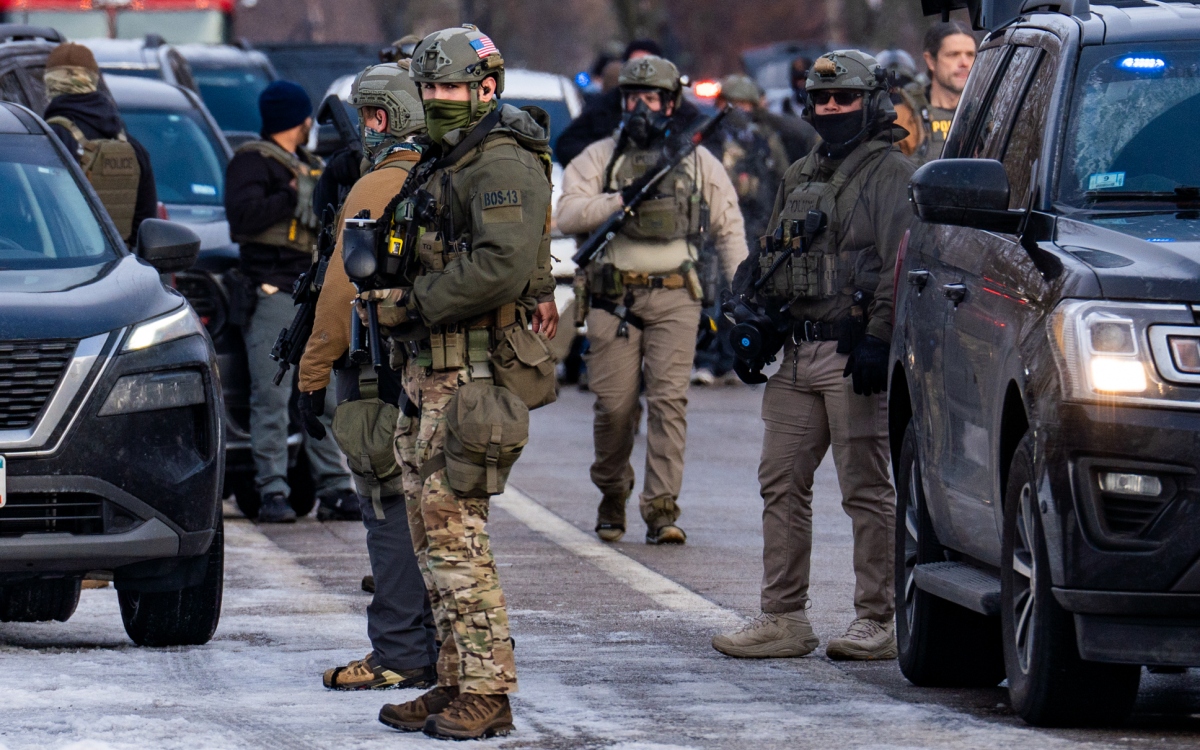
Federal ICE agents congregate on Portland Ave in Minneapolis near where Renee Good was shot to death. (Photo: Chad Davis)
The Trump administration is in a heated legal battle over abusive ICE tactics leading to illegal arrests, warantless searches and brutal assaults on Minneapolis protesters.
U.S. District Court Judge Katherine (Kate) Menendez issued a sweeping preliminary injunction Jan. 16 curbing abusive tactics used by federal immigration agents (ICE) during “Operation Metro Surge” in Minneapolis.
But the 8th U.S. Circuit Court of Appeals yesterday (Jan. 21) suspended Judge Menendez’s order following an appeal by the Trump Department of Justice (DOJ)
More Reading: Trump Slurs Against Opponents, Immigrants, Media Worsen as Economy Falters; How Low Will He Go?
This administrative stay temporarily restores the authority of immigration agents to use these tactics while the Trump administration pursues a full appeal of the district court’s decision.
Menendez’s ruling prohibited federal agents from:
- Targeting Peaceful Protesters: Agents were barred from arresting, detaining, or using force against “peaceful and unobstructive” protesters and observers.
- Using Crowd Control Munitions: The order specifically banned the use of pepper spray, tear gas, and other nonlethal crowd dispersal tools against demonstrators or bystanders recording enforcement actions.
- Stopping Vehicles Without Cause: Agents were prohibited from stopping or detaining drivers and passengers unless they had “reasonable articulable suspicion” that the individuals were forcibly interfering with law enforcement operations.
The ruling came almost 10 days after the death of Renee Good, a Minneapolis mother of three, who was shot by an ICE agent on Jan. 7, as she was attempting to leave the scene of ICE operations in the Twin Cities.
The State of Minnesota, along with the cities of Minneapolis and St. Paul, filed a lawsuit on Jan 12, to halt these tactics, alleging they violate the Tenth Amendment by “commandeering” local police resources to manage the chaos created by federal agents.
The American Civil Liberties Union of Minnesota filed its lawsuit on Dec. 17 on behalf of six protesters who alleged federal agents violated their constitutional rights.
The suit was filed against the U.S. Department of Homeland Security and other federal agencies, three weeks before an immigration agent fatally shot Good.
The lower federal court’s injunction in the ACLU case had restricted federal immigration agents in Minnesota from using aggressive tactics—such as tear gas, pepper spray, and “non-lethal” munitions—against peaceful protesters.
More Reading: Trump Mass Deportation Shaping Up to Be First Administration Fiasco
But government lawyers argued that officers would be hindered from protecting themselves and the public during “very dangerous circumstances.”
The 8th Circuit’s did not comment or issue any determination on the matter. It only issued a one-sentence order that paused the restrictions while the government’s challenge undergoes an initial review.
ICE agents have been conducting immigration inforcement actions in the Twin Cities since December as part of “Operation Metro Surge.” a
Protests began as soon as ICE agents hit the streets and tensions in the region have been rising following the fatal shooting of Good and other incidents involving abusive tactics and warrantless arrests and home invasions.
DHS officials state the focus is on “criminal illegal aliens,” including those with convictions for homicide and gang activity, and boast of 3,000 arrests so far. But rights advocates say only 240 of those cases involve felony offenders.
More Reading: Trump Has Long Fetishized Violence; Gives ICE Carte Blanche to Satisfy His Fixation
A controversial internal ICE memo dated May 2025 (which surfaced this month) authorized agents to enter private residences using only administrative warrants—which are signed by ICE officials rather than judges.
The tactic amounts to a clear violation of Fourth Amendment protections against unwarranted searches and seizures., acccording to legal experts.
In a separate ruling in Oct. 2025, a federal judge in Chicago extended the Castañon Nava consent decree until Feb. 2. It blocks ICE agents from arresting individuals without a warrant or probable cause in the Chicagoland area.
Images on this page are licensed under the Creative Commons Attribution 4.0 International license.