

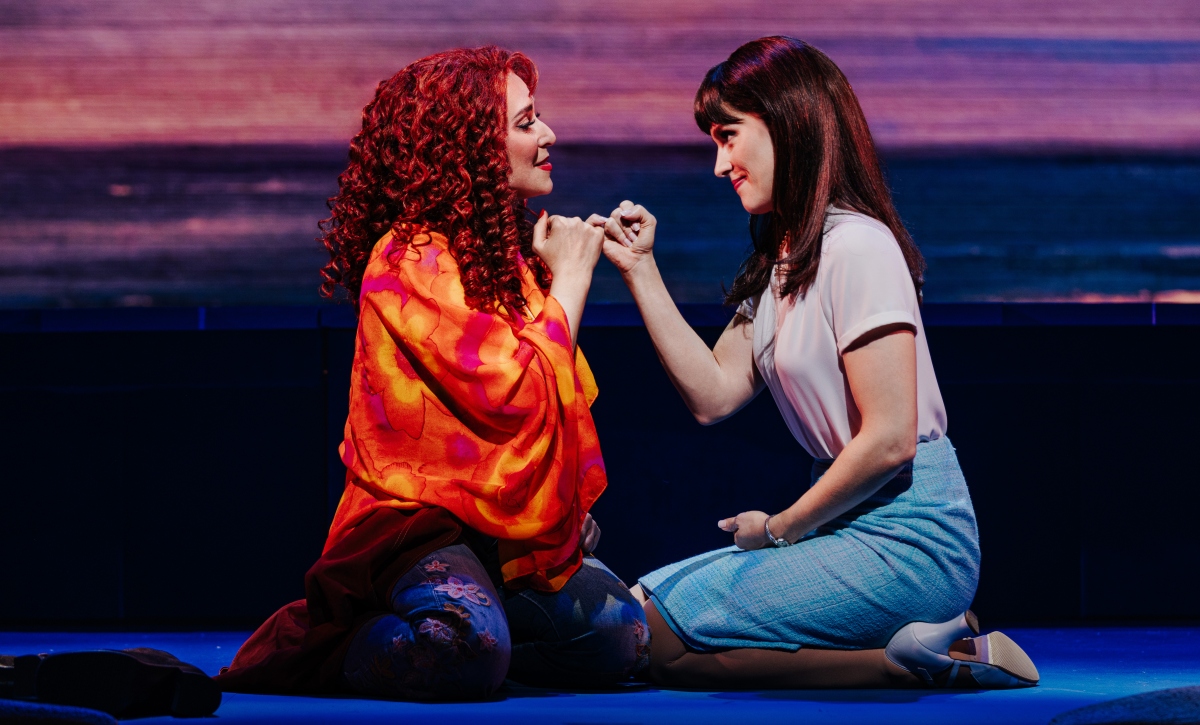
Jessica Vosk and Kelli Barrett-are forced to carry the weight of a so-so production in the new Broadway musical Beaches. (Photo: Marc J. Franklin)
Broadway musical Beaches arrives with a built-in emotional advantage: audiences already know and love the story. Unfortunately, it struggles to justify its existence.
Iris Rainer Dart’s and Thom Thomas’ stage adaptation of the 1988 film, based on Dart’s novel, feels dramatically thin, visually underwhelming, and musically forgettable.
Like the novel, the musical is about an unlikely, lifelong friendship forged between two women from vastly different worlds.
At its core, Beaches follows the decades-spanning relationship between Cee Cee Bloom (Jessica Vosk), an ambitious and brash performer, and Bertie White (Kelli Barrett), a reserved woman born into privilege.
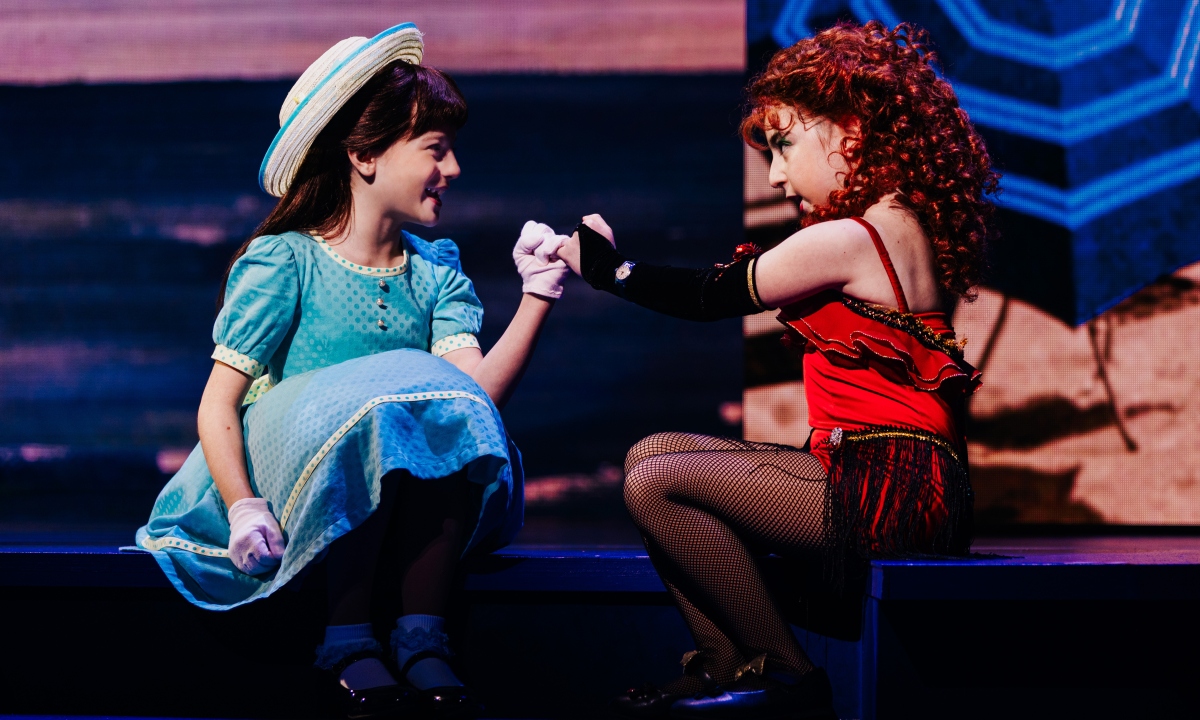
Zeya Grace (left) and Samantha Schwartz charm as little Bertie and little Cee Cee in Broadway’s Beaches. (Photo: Marc J. Franklin)
The two meet as children (played by Zeya Grace and Samantha Schwartz) and remain bound together through careers, romances, rivalries, and personal hardships, culminating in a final act shaped by illness and loss.
It’s a narrative that thrives on intimacy and emotional payoff-qualities that are strangely diluted in this production. Where the show does succeed is in its performances, particularly from Vosk and Schwartz.
Vosk delivers a commanding and vocally powerful portrayal, imbuing Cee Cee with the necessary grit and vulnerability that Bette Midler demonstrated in the 1988 film. She manages to elevate even the weaker material, bringing genuine emotional stakes to moments that otherwise feel underwritten.

Jessica-Vosk delivers a standout performance in Broadway musical Beaches. (Photo Marc-J.-Franklin)
As young Cee Cee, 10-year-old Schwartz demonstrates talent beyond her years, with sass, charm, and chutzpah that make her an instant star. In one of many standout moments, she is belting while upside down…doing a handstand!
Beyond these performances, the production falters.
James Noone’s scenic design is notably sparse, relying heavily on projections that feel more like placeholders than intentional artistic choices. Rather than enhancing the storytelling, the projections often create a sense of detachment, preventing scenes from fully coming to life.
The minimal physical environment leaves the actors little to interact with, diminishing the sense of place and time that is so crucial to a story spanning decades.
Pivotal scenes take place on a beach that is flat and left to the imagination through lighting.
Tracy Christensen’s costumes attempt to signal the passage of time and shifts in character status, but they rarely make a lasting impression. While functional, they lack the specificity and flair needed to define character or era in a memorable way.
Similarly, Ken Billington’s lighting design feels uninspired, doing little to heighten emotional beats or create visual texture. It serves its purpose but rarely contributes meaningfully to the storytelling.
The script and music are perhaps the production’s greatest weakness.
Stripped of the nuance and depth that made the original film so compelling, the stage version (with a book by Dart and Thomas, music by Mike Stoller, and lyrics by Dart) often feels episodic and rushed.
Key emotional moments land with less impact, and the dialogue frequently leans on clichés rather than offering fresh insight into these characters.
Lonny Price’s and Matt Cowart’s direction does little to compensate, resulting in a show that feels oddly static, with transitions that lack fluidity and scenes that fail to build momentum.
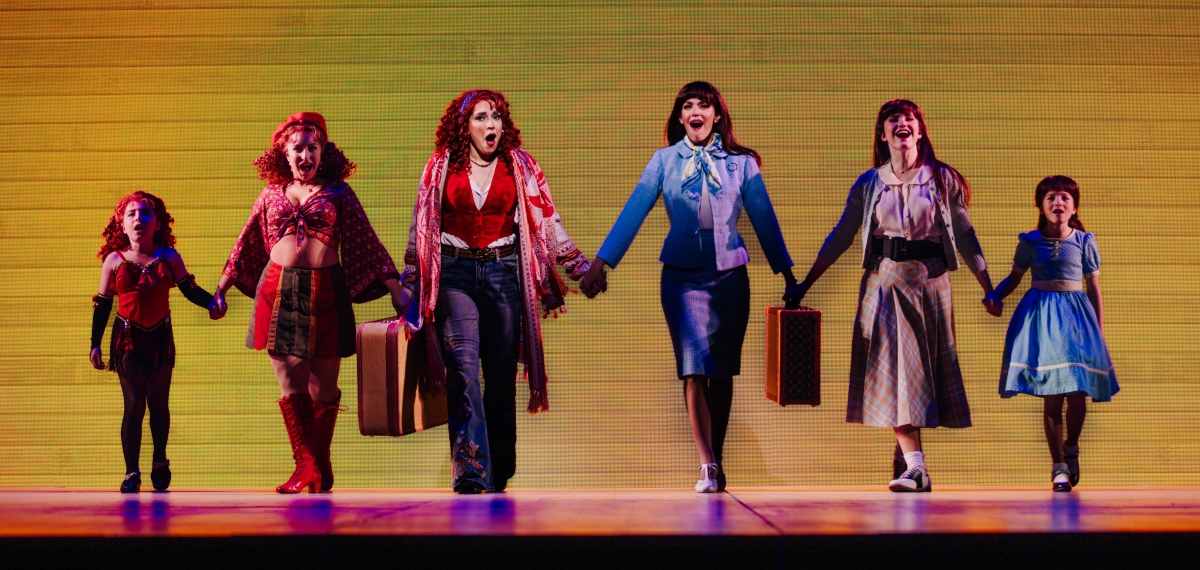
The cast of Beaches, from left: Samantha Schwartz, Bailey Ryon, Jessica Vosk, Kelli Barrett, Emma Ogea, and Zeya Grace (Photo: Marc-J.-Franklin)
Most disappointing is the score, which ultimately adds little to the experience. The songs are largely indistinguishable, failing to capture the emotional complexity or iconic status of the film’s music.
Rather than enhancing the narrative, the musical numbers often feel like interruptions, slowing the pacing without providing memorable melodies or lyrical depth. In a story so closely associated with powerful music, this absence is particularly glaring.
In the last gratuitous moment, audiences are gifted a concert version of “Wind Beneath My Wings,” a cringeworthy example of pandering at best.
In the end, Beaches on Broadway feels unnecessary — a production that neither reimagines nor deepens its source material.
Despite Vosk’s and Schwartz’s undeniable talents, whose performances rise above the material, the show struggles to find a compelling reason to exist.
What remains is a well-intentioned but ultimately forgettable adaptation that pales in comparison to the story audiences already know and love.
For more information about click here: Beaches.