






















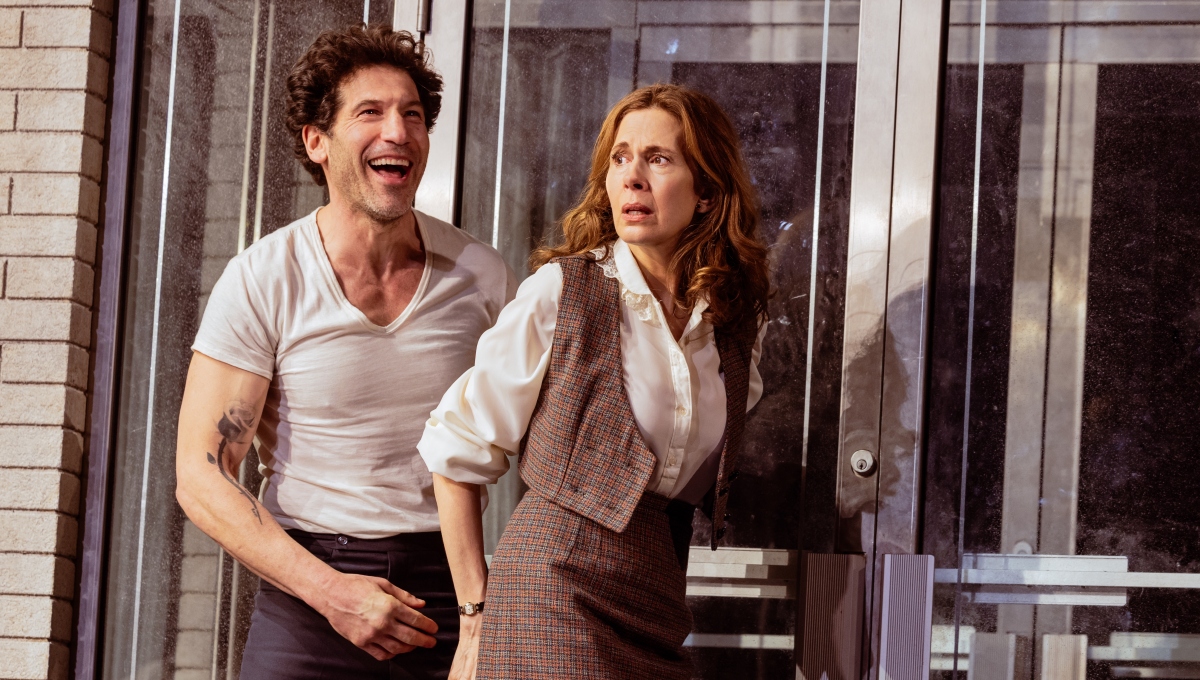
The Broadway adaptation of the 1975 crime film classic “Dog Day Afternoon” arrives with the weight of expectation, and the long shadow of Sidney Lumet’s searing direction and Al Pacino’s career-defining role as bank robber Sonny.
What unfolds at the August Wilson Theatre, however, is not a taut, suspenseful retelling, but something far stranger: a tonal departure that often feels less like a hostage thriller and more like an offbeat, HBO comedy loosely inspired by real events.
At first glance, the production, under the direction of Rupert Goold, retains the familiar bones: a Brooklyn bank, a botched robbery, a sweltering day.
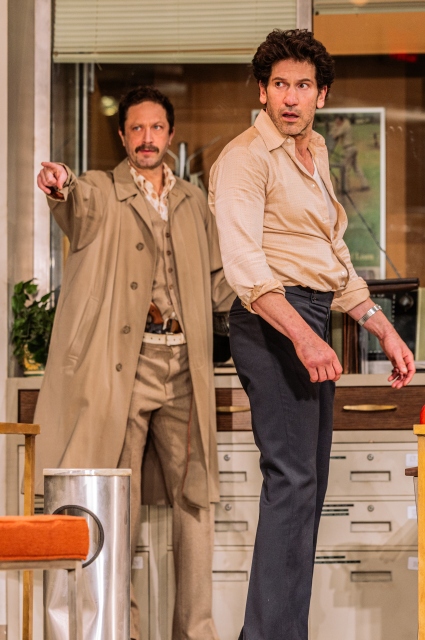
But under Goold’s direction of a script by Stephen Adly Guirgis, the story is reshaped into a largely comedic affair.
Where the film is known for its psychological pressure and moral ambiguity, this version waters down its own stakes with a steady stream of jokes and winking asides. The result is a curiously low-stakes experience for a story rooted in desperation, criminality, and media frenzy.
One gets the uneasy sense that, despite the drawn guns, everything will reset neatly by the time the credits roll.
At the center is Sonny, played here by Jon Bernthal, who gives a performance that strays from Pacino’s jittery intensity. Bernthal’s Sonny is smoother and more charming, almost to the point that it is disarming.
He flirts, he jokes, and he glides through the chaos with an easy charisma. Bernthal is undeniably watchable and a treat to behold, but it contributes to the larger sense that the production is unwilling to fully address the character’s instability or the severity of his actions.
Opposite him, Ebon Moss-Bachrach’s Sal, Sonny’s partner in crime, fades into the background. He lacks the menace or bleakness needed to ground the story, while Hecht brings her usual influence to head teller Colleen, even if the role does not seem to be written as a fully realized person.
This tonal shift is most evident inside the bank. The employees (ostensibly hostages, led by the great Jessica Hecht) rarely register genuine fear, instead trading quips and settling into an almost jovial rhythm with their captors.
The atmosphere is less pressure cooker than break room, creating heightened, caricatured office antics rather than the volatile realism of Lumet’s film. Even moments of violence land with a disconcerting softness, as if the production is determined to sand down every sharp edge.
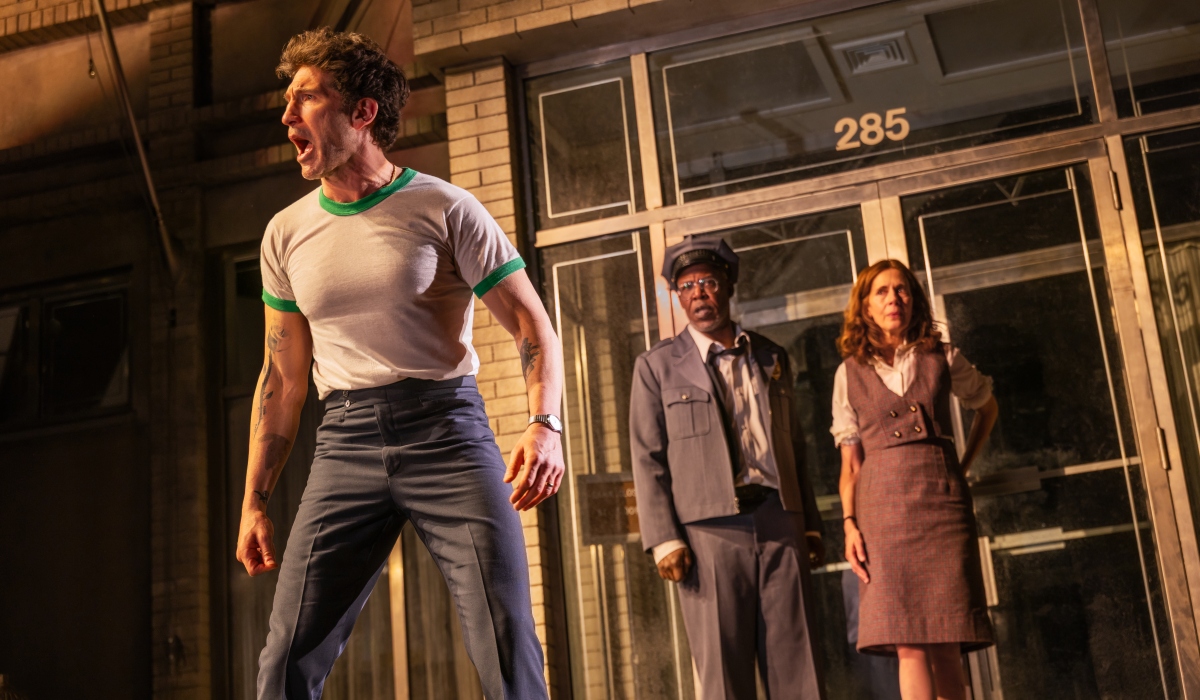
Across the ensemble, characters often feel flattened into comic sketches, their inner lives forfeited for jokes. Their experience gets the laughs, but in doing so makes the story ineffectual.
The production does take creative license with theatricalizing the iconic moments. Goold invites the audience to become the chanting crowd outside the bank, echoing the infamous “Attica!” moment, while police officers infiltrate the aisles of the theater.
However, even this device feels somewhat forced, its energy inconsistent, its impact dampened and comical.
What should be a shocking turning point instead plays like a half-hearted breaking of the fourth wall, with an opportunity for audience participation.
To that end, there is humor.
Guirgis’s script lands occasional barbs, and the audience responds. But humor definitely comes at a cost here. By leaning so heavily into comedy, the play loses its urgency, its danger, and ultimately its meaning.
The real-life 1972 robbery, and Lumet’s acclaimed film adaptation, toiled with media spectacle, social upheaval, and human desperation. This version barely taps at the surface of the ingrained themes.
David Korins’ richly detailed rotating set becomes a character itself, placing the audience both inside and outside the bank; paired with Isabella Byrd’s superb lighting, it makes for exceptional technical theatre.
In the end, this Dog Day Afternoon is a questionable reinterpretation-an amalgamation of sorts, as it is neither a faithful homage to the film, nor an impressive reinvention.
It may elicit a number of laughs and highlight a charismatic performance from Bernthal, but it rarely grips, and it never devastates. For a story that once felt like a live wire, that’s the greatest loss of all.
For more information or to purchase tickets for Dog Day Afternoon, click here.

Iris Wiener is an entertainment writer, editor, reporter and theatre critic based in New York. Her portfolio contains a diverse collection of work on all genres of entertainment. Her reporting has been featured in more than twenty publications, including Newsday, Playbill, TheaterMania, Encore Monthly, Weston Magazines, and Long Island Woman. She is a proud voting member of the Drama Desk and The Outer Critics Circle.