























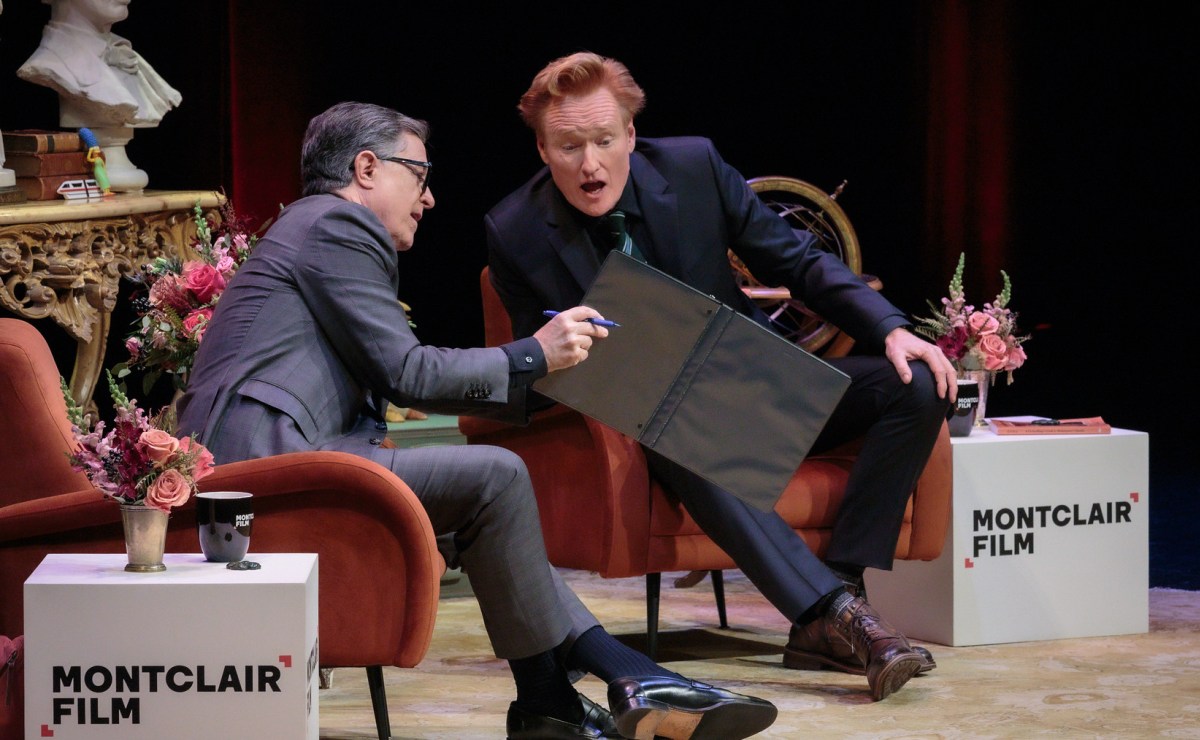
Stephen Colbert and Conan O’Brien, two of the most recognizable voices in comedy, sparred and meandered their way through stories and asides at Newark’s New Jersey Performing Arts Center (NJPAC).
The comedians and social commentators swapped memories, reflected on the shifting terrain of show business, reopened a few old industry scars, and fielded unruly, delightfully antagonistic questions from the crowd.
As the conversation wound down, it was clear that the night had delivered exactly what Montclair Film set out to celebrate—not just a famous career, but the messy, communal, deadline-driven process of becoming who you are.
In that room at NJPAC, laughter wasn’t just entertainment. It was evidence of a life lived all in, and a story still being written.
Colbert walked onstage, and set the tone for the night in his unmistakable way.
“Congratulations on being interviewed by me, Conan,” he said, as the audience erupted.
Conan smiled, a familiar mix of mock humility and mischief, and settled into the chair across from him. What followed was less an interview than a shared excavation of a life spent chasing laughter.
O’Brien was a blur of nervous energy and razor-sharp improvisation, as buoyant and unfiltered as he was during his now-infamous Hot Ones turn; He paused only occasionally to offer a flash of perspective earned the hard way.
Colbert stayed crisply composed as he interviewed O’Brien, keeping his cards close and deploying his full hosting skill set to gently reign in the former “Tonight Show” host whenever he threatened to careen joyfully off course.
Conan spoke about how long it took him to understand what he was doing. “Late in Obama’s second term, I realized I could get good at this,” he admitted.
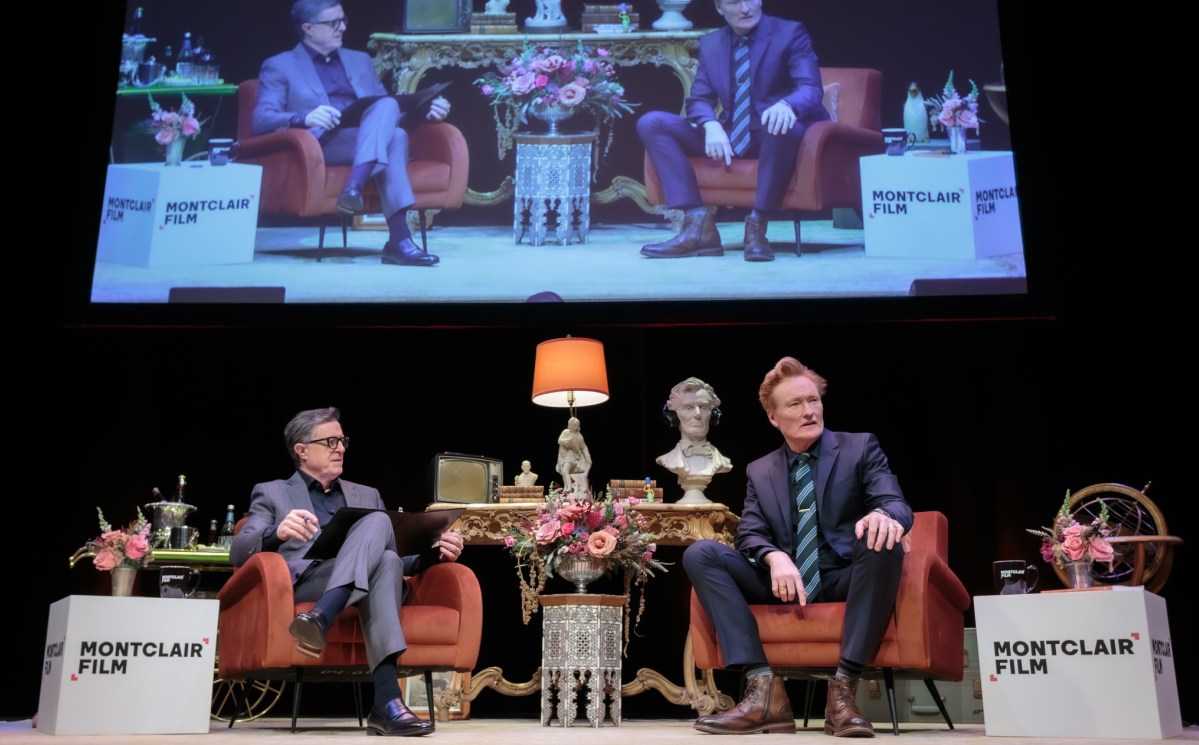
The crowd seem to understand the irony of a decades-long career described as a warm-up.
The roots of that career stretched back to childhood, to a moment that clarified everything.
“When I saw my parents laugh hard,” he said, “that was my reason for everything.”
Even then, the impulse to be funny outweighed the rules. In a fourth-grade production of Oklahoma, Conan went off book—not because he forgot his lines, but because he was trying to make people laugh.
That instinct hardened into something more urgent as he grew older. “I had a burning desire to be someone,” he said, plainly.
Three days into his freshman year at Harvard, that desire led him to meeting at the Harvard Lampoon, the campus humor magazine that had a brief run as a national publication.
Writing for the magazine was the first time something came easily to him. “It was my life. My religion,” he says.
By his sophomore and junior years, he was running the magazine, immersed in deadlines and jokes and the strange comfort of creative pressure.
“You have to have a deadline,” he later reflected. “You loathe them, and they’re miraculous.”
College also gave him moments of surreal validation.
He once gave the late comedian an actor John Candy a tour of campus, an encounter that stayed with him.
“He was everything I wanted him to be. He was Falstaff,” Conan said.
Candy’s advice was simple and absolute: “You don’t try comedy. You have to go all in.” Conan carried that with him, a guiding rule rather than a suggestion.
Colbert steered the conversation toward Conan’s self-criticism, which Conan described with characteristic bluntness.
“With comedy, I’m hyperjudgmental with myself. Music is something I do for me.”
He then promptly undercut the seriousness by describing the interview itself as “a rectal exam,” reminding everyone that sincerity and absurdity have always coexisted in his work.
The night wandered through near-misses and unlikely turns.
Conan recalled doing improv with “Friends” star Lisa Kudrow when he got the call to audition for “The Late Show.”
During that audition, he interviewed Mimi Rogers and Jason Alexander.
He also admitted—without apology—that he did not hire Colbert or comedian Ray Romano early on, a confession Colbert received with theatrical grace.
As Conan scanned the audience, he acknowledged familiar faces, including longtime collaborator Robert Smigel.
The sense of community in the room deepened—writers, performers, fans, all part of the same extended story.
When asked about optimism, Conan offered a number rather than a platitude.
“I am a 52 percent optimist,” he said. “I believe humans find a way. They will use what’s available to make hilarious things.”
That belief has carried him into new formats, including a podcast that began almost as a joke. The freedom it offered allowed him to be as strange as he wanted—even in front of guests like legendary actor Al Pacino.
During audience questions, Conan swerved happily into the ridiculous.
He explained that he had never appeared on “Law & Order,” the popular television crime series, because it was beneath him.
He hasn’t done Broadway either, insisting, “I was put on earth to do ‘Ya Got Trouble’ from The Music Man. I’m not interested in doing anything else. I’m open to things that scare me.”
The evening inevitably circled back to one of the most public moments of his career: being fired to make way for Jay Leno’s return to “The Tonight Show.”
Conan didn’t linger on bitterness. Instead, he offered advice shaped by his experience. “If you stay in the game and just tread water,” he said, “things will change and get better.”

Iris Wiener is an entertainment writer, editor, reporter and theatre critic based in New York. Her portfolio contains a diverse collection of work on all genres of entertainment. Her reporting has been featured in more than twenty publications, including Newsday, Playbill, TheaterMania, Encore Monthly, Weston Magazines, and Long Island Woman. She is a proud voting member of the Drama Desk and The Outer Critics Circle.